
Taylorism in Management Explained and Why It Still Matters

Have you ever wondered why some workplaces feel like well-oiled machines while others seem stuck in chaos?

The answer often traces back to a management theory born over a hundred years ago: Taylorism in management.
Back in the early 1900s, Frederick Winslow Taylor introduced a new way of running factories. He called it scientific management. The goal was simple. Break every job into tiny steps. Time each motion. Find the “one best way” to do the work. Taylor believed that by using data and observation, managers could boost productivity and eliminate waste. Today, we call this approach Taylorism, also known as scientific management.

And here’s the thing. Taylor’s ideas really did revolutionize industrial production. Factories became faster. Output soared. But there was a dark side too. Workers often felt treated like machines. They resisted the rigid control. Early implementations led to worker resistance and distortions. So even as Taylorism transformed business and management, it sparked a debate that still rages in 2026.
In this article, we’ll explore the core principles of Taylorism, the sharp critiques it drew, and how it has evolved over time. We’ll also look at its surprising relevance in modern workplaces. Because understanding where our management habits come from can help you think more clearly about how you lead, learn, and work. And if you want to evaluate any management theory with a sharp eye, strengthening your inner authority is a great place to start.
Let’s begin by breaking down Taylor’s original principles.
What Is Taylorism? Definition and Origins
So what exactly is Taylorism in management? At its core, Taylorism is the same thing as scientific management. It is a systematic way to boost how much work a person can do in a given time. Instead of relying on guesswork or old habits, managers use data and observation to find the fastest, most efficient way to complete each task. Then they teach that method to every worker. The goal was to make factories run like precise machines.
This idea did not come out of nowhere. It was created by a man named Frederick Winslow Taylor in the late 1800s. Taylor was a mechanical engineer who worked in steel factories. Back then, factories were growing fast, but they were chaotic. Workers did tasks the way they had always done them, often wasting time and energy. Taylor thought there had to be a better way. He started timing workers with stopwatches and recording every single motion. He believed that if you could measure work, you could improve it. An overview from Indeed explains that scientific management is all about applying Taylor’s theory to improve economic efficiency.
Taylor laid out his ideas in a famous book called The Principles of Scientific Management, first published in 1911. The book became a cornerstone for modern business and management. In it, Taylor argued that there is “one right way” to do any job. He called for managers to take control of the work process and use science to design it. This approach revolutionized manufacturing by turning work into a precise, repeatable process. But it also treated workers like cogs in a machine, which caused a lot of pushback.
Understanding where Taylorism came from helps you see why some workplaces still feel so rigid today. And being able to critically examine ideas like this is a valuable skill in any business role. If you want to strengthen your ability to evaluate management theories on your own, check out this guide to critical thinking for business professionals. It will help you ask the right questions about any approach, old or new.
The Four Core Principles of Scientific Management
Taylor did not just have a vague idea. He wrote down a clear system with four core rules. These rules changed how factory work was done. They became the science of management for many decades. Understanding these rules is the best way to grasp taylorism in management and how it still affects business and management today.
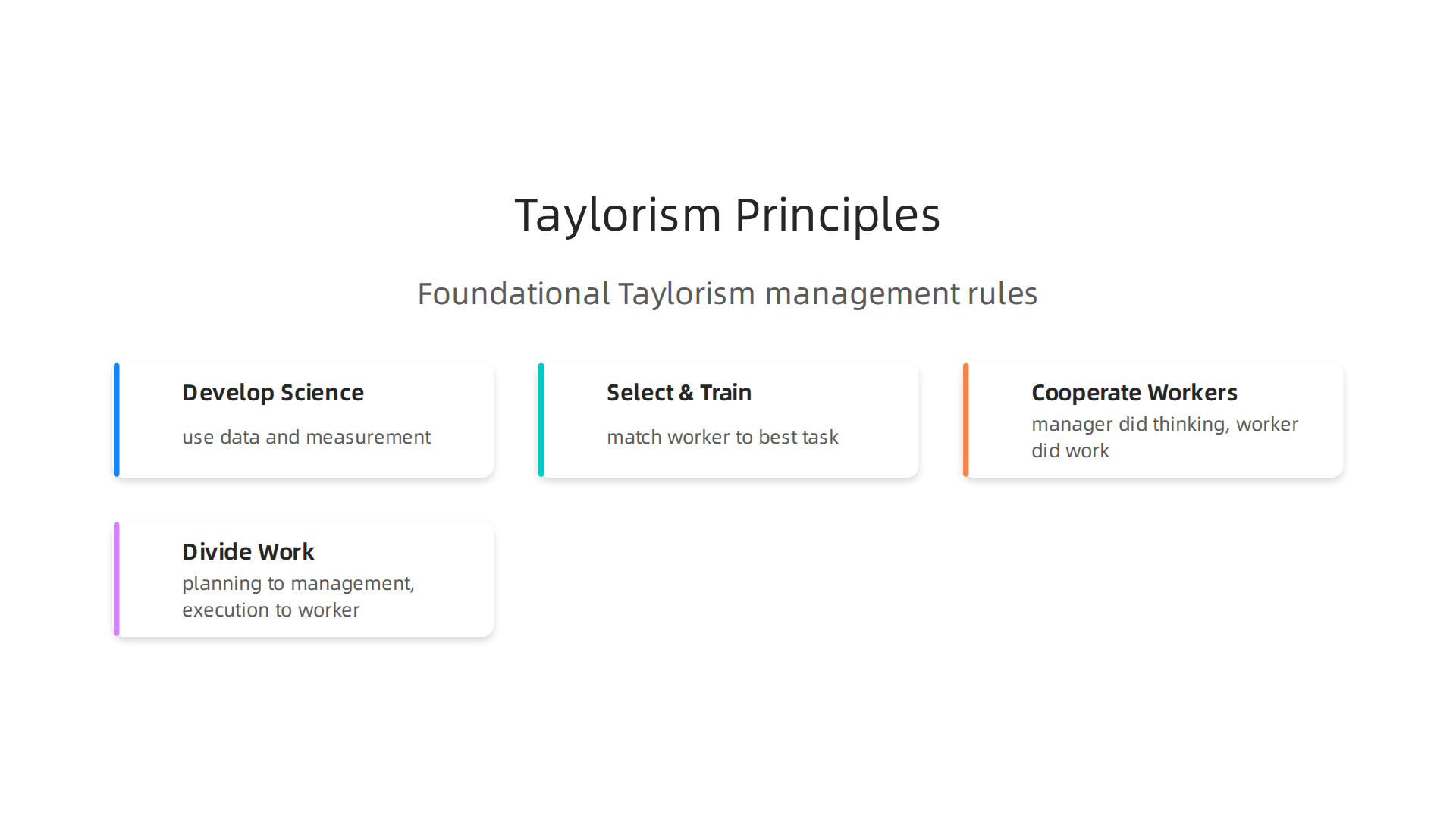
1. Develop a Science for Each Task (Science, Not Rule of Thumb)
Taylor said managers should stop relying on tradition or guesswork. Instead, they should use data and measurement. His famous example was the pig iron experiment at Bethlehem Steel. Taylor timed workers and studied their every movement to find the fastest way to lift and carry iron. He showed that using a scientific method could triple daily output by finding the "one right way" to do the job. This was a huge shift. Before Taylor, skilled craftsmen did work based on habits passed down through years of experience. Under Taylor, management took control and designed the method from scratch.
2. Scientifically Select and Train Workers
In the old craft system, workers often picked their own jobs or learned from a parent. Taylor thought this was wasteful. He argued that managers should use science to match each worker to the task they were best suited for. Then, they must train that worker step by step in the one best method. This principle of scientific management meant workers were no longer apprentices learning by trial and error. They were trained like precision tools. In an early 1900s machine shop, a worker might spend hours filing metal with no clear technique. Taylor’s method would put that worker through a short training session to learn the fastest filing motion.
3. Cooperate with Workers to Follow the Science
Taylor believed managers and workers should work in close partnership. But the cooperation was not equal. The manager did the thinking and planning. The worker did the physical work. If a worker wanted to do a task differently, the manager was supposed to step in and correct them. This cooperation was meant to ensure that the science of management boosted production without resistance. In a craft shop, the worker decided the pace and details. In Taylor’s system, the manager set the pace and the method.
4. Divide Work and Responsibility Between Managers and Workers
This was the most radical principle. Taylor said that nearly all the planning, thinking, and decision-making should belong to management. The worker’s job was to execute the plan exactly as instructed. The worker no longer had to figure out how to do the job. That job belonged to the manager. This clear division of work and responsibility separated the planning from the doing. In a pre Taylor factory, a machinist might decide the order of his cuts. Under Taylorism, a manager would give him a card with each step, the tool to use, and the exact time allowed.
These four principles made factories more productive than ever. But they also stripped workers of creativity and control. If you want to dig deeper into how these management ideas shape careers today, exploring business majors can show you where these theories still apply. Check out this guide for choosing the right path for your career in business and management.
Historical Context: Taylorism’s Impact on Industry and Society
Those four principles did not stay inside one factory. They spread across the world like wildfire. In the early 1900s, taylorism in management traveled from the United States to Europe and then to Japan. Factory owners everywhere wanted that same boost in output. By the 1910s, European engineers and managers were already studying Taylor’s methods and applying them in their own factories. The science of management became the standard way to run a plant, a mill, or a shop floor.
The most famous example of Taylor’s ideas in action was Henry Ford’s assembly line. Ford took Taylor’s principles and pushed them even further. Instead of having workers move around, he brought the work to them on a moving belt. Each worker did one small task over and over. This combination of Taylor’s scientific method and Ford’s mechanical system created the era of mass production. Suddenly, factories could make cars, clothes, and appliances faster than anyone had thought possible. The price of goods dropped. More people could afford things they once could not.
But not everyone celebrated this new way of working. Many workers hated it. They felt like machines instead of people. Unions fought back hard.

They argued that Taylor’s system took away all the skill and pride from work. Why would a worker care about quality if a manager told them exactly what to do every second? There were strikes, protests, and even government hearings about the human cost of scientific management. Workers wanted a say in how they did their jobs, not just a set of commands.
This tension between efficiency and humanity is still with us today. If you are studying business or management now, understanding where these ideas came from helps you see why some workplaces feel so rigid. Learning to think critically about management systems can give you the tools to build fairer, smarter work environments. That skill is just as valuable in 2026 as it was a century ago.
Critiques and Limitations: Why Taylorism Fell Out of Favor
For all its early success, taylorism in management had a big blind spot. It treated people like parts of a machine.
If a worker was tired, bored, or unhappy, the system did not care. The only thing that mattered was the speed of the output. But as the twentieth century went on, researchers and workers started to prove that this view was wrong.
The first major crack in Taylor’s ideas came from a series of experiments at the Hawthorne Works factory in the 1920s and 1930s. Researchers found that workers did not just respond to pay or time studies. They responded to being noticed. When workers felt like someone cared about them, their productivity went up, no matter the physical conditions. This became known as the Hawthorne Effect. It gave birth to the human relations movement. Psychologists showed that social connections, group norms, and a sense of meaning matter just as much as a stopwatch. Taylor’s science of management had completely missed the human side of work.
That missing piece also led to serious ethical problems. Taylorism turned skilled craftsmen into simple button pushers. Experts called this deskilling. A worker who once built an entire shoe now only glued the sole. Unions argued this stripped work of all dignity and pride. Workers lost control over their own methods. They became interchangeable parts. When you treat people like that, resentment grows. Strikes and turnover went up, and loyalty went down.
Then there were the practical limits. Taylor’s system worked great for repetitive, physical tasks on an assembly line. But it failed badly in areas that needed thinking. You cannot time a researcher, a designer, or a software developer with a stopwatch and get good results. Knowledge work requires flexibility, creativity, and trust. A rigid system that demands one best way kills innovation.

By the mid 1900s, companies realized that taylorism in management could not handle a world that was changing fast.
So the question becomes: if Taylorism is too rigid and dehumanizing, what should you use instead? The answer is not about throwing out all structure. It is about learning to think critically about different business and management approaches and choosing what fits your people and your goals. That is exactly the kind of skill you can develop today.
When you learn to question assumptions, evaluate evidence, and consider human factors, you become a better leader. Building those analytical muscles takes practice, but courses and resources are available to help you grow. One of the most valuable things you can gain is the confidence to trust your own judgment under pressure. Clear thinking needs self-trust under pressure. Strengthen your inner authority with the right tools.
Evolution: From Taylorism to Modern Strategic Management
So if Taylorism was so rigid, what came next? The answer is not one single theory. Instead, a whole family of new ideas grew out of each other, creating the business and management world we know today.
The first big change was the human relations movement. Starting in the 1930s, managers began to care about workers as people.
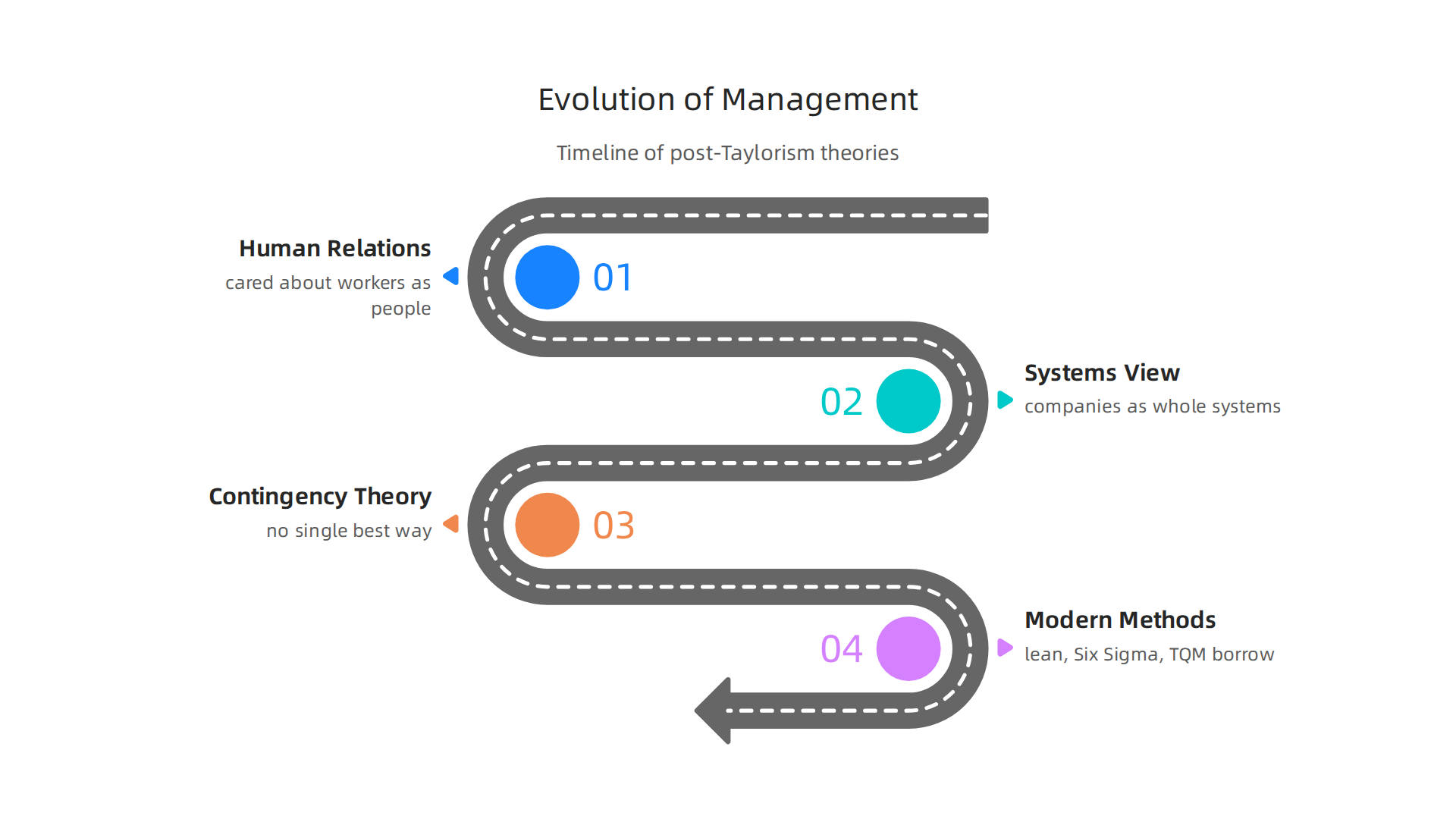
They learned that happy employees work harder. This led to studies on motivation, leadership, and team dynamics. As the timeline of management theories shows, this human focus opened the door to many other approaches.
By the 1950s and 1960s, thinkers started looking at companies as whole systems. They realized you cannot change one part without affecting everything else. This systems view helped managers see the big picture. Then came contingency theory, which said there is no single best way to run a company. The right method depends on your situation, your people, and your market. This was a big step away from Taylor’s one best way.
But here is the twist. Even with all these changes, some parts of taylorism in management never really died. They just got smarter. Modern methods like lean production, Six Sigma, and total quality management all borrow from Taylor’s obsession with data and process. They use statistics, measurements, and standard steps to reduce waste. The difference is they also involve workers in improving the process, rather than treating them like machines. Many essential management theories from Taylor are still alive inside these systems today.
In 2026, the best companies mix both worlds. They use data from science of management to measure performance. At the same time, they invest heavily in employee engagement and behavioral economics. They understand that people are emotional, social, and complex. This means modern managers need to be flexible. They must know when to use a stopwatch and when to use a listening ear.
If you want to lead in today’s world, you need to think critically about which tools fit your team. You cannot just copy Taylor or any other single method. You need to understand the history, see what works, and adapt. Building that kind of thinking is a skill you can practice. Learning how to evaluate management programs and certifications is a great way to start. The evolution from Taylorism is not over. You get to be part of it.
Taylorism in the 21st Century: Relevance and Adaptation
Think about the last time you ordered fast food, got a package delivered, or called a customer service line. Chances are, you experienced a modern version of taylorism in management. The same principles that Taylor used a century ago are still alive in logistics, fast food restaurants, and call centers. These industries break work into tiny, repeatable steps and measure every second of your performance.
But in 2026, the biggest new home for Taylorism is not a factory floor. It lives inside algorithms. This is often called digital Taylorism or algorithmic management. A recent study describes algorithmic management as a defining feature of the global gig economy, where automated systems constantly monitor, measure, and control workers instead of human bosses. Platforms like rideshare apps and food delivery services use these systems to direct every move. Researchers have found that this kind of digital Taylorism leads to constant surveillance and pressure. The Human Rights Watch has documented how these systems can create serious rights abuses for workers.
So where does this leave us? We now have a huge debate between efficiency and human autonomy. On one hand, algorithmic management can make operations incredibly efficient. On the other hand, it can strip away a worker’s sense of control and dignity. Studies from New York’s gig economy show that workers feel surveilled and directed at every turn. Balancing the productivity gains from the science of management with the need for human well being is one of the biggest challenges for business and management today.

To navigate this world, you need to think critically about the systems you use and the work you do. Understanding how these digital tools operate is the first step toward protecting your own autonomy. If you want to strengthen your inner authority and make clear decisions even under pressure, check out this resource on Strengthening Inner Authority. You can also explore this guide on evaluating online programs to build skills that help you adapt to modern management challenges.
Summary
This article explains Taylorism (scientific management), the early-20th-century system Frederick W. Taylor created to boost factory productivity by timing tasks, standardizing methods, and separating planning from doing. It walks through Taylor’s four core principles, shows how his ideas powered mass production yet provoked worker resistance, and traces the historical shift from pure Taylorism to human-centered and systems-based management. The piece also examines modern descendants of Taylorism — from lean and Six Sigma to algorithmic management in gig platforms — and highlights the ethical and practical limits of applying rigid measurement to human work. Readers will learn how to recognize Taylorist practices, where they still add value, the common pitfalls to avoid, and how to combine data-driven process design with employee involvement so productivity gains don’t come at the cost of dignity or innovation.