Critical Thinking for Business Professionals in 2026 Evaluate Online Programs to Boost Your Career

Introduction: Why Critical Thinking Is the New Business Imperative
Every day, you face a flood of data, emails, reports, and urgent decisions.

The pace keeps accelerating, but your mental energy does not grow with it. In 2026, this overload has become one of the biggest challenges for any business professional.
Here is the hard truth: most organizations are not ready for it. According to a recent survey, only 5% of companies have the skills and headcount they need for priority projects. And a McKinsey study found that just 30% of organizations feel equipped to handle today’s demands.
The gap is real, and it is quietly holding people back.
But here is the good news. The skill that matters most right now is not a new software tool or a technical certification. It is critical thinking. The ability to slow down, question assumptions, weigh evidence, and make sound decisions under pressure. That is what drives better strategy, smarter innovation, and faster career growth.
And you do not need a four-year degree to build it. Flexible options like professional development courses, free business courses, and online programs make it easier than ever to grow this skill on your own time. In fact, you can explore some of the top options in The Best Online Learning Platforms for Critical Thinking in 2026.
In this guide, we will walk through practical, no fluff frameworks you can start using today to think clearer, decide smarter, and stand out as a leader. If you want to start learning practical frameworks, examples, and exercises to improve your reasoning and decision-making, Get Started here.
The Critical Thinking Gap in Business: Why It Matters
Here is the reality. In 2026, your ability to think clearly is more valuable than ever. But most business professionals are not ready for the challenge. A recent Robert Half survey found that only 5% of organizations have the skills and headcount needed for priority projects. And according to a McKinsey study reported by ProTen International, just 30% of organizations feel equipped to handle today’s demands. This gap is not just a hiring problem. It is a thinking problem.
One of the biggest issues is that many managers struggle to separate reliable data from misinformation. With so much information flying at you every day, it is easy to accept bad data by mistake. Over one-third of businesses report difficulty finding candidates with the right skills, according to a Statistics Canada analysis. And a DataCamp report shows that 60% of organizations face a data literacy gap, even though 88% say it is essential. That disconnect leads to costly errors and wasted effort.
Dean Grey’s research shows that information overload can weaken your judgment. Without strong analytical habits, teams make decisions based on gut feelings or the loudest voice in the room. This lack of rigor does not just cause mistakes. It holds back innovation. When people cannot question assumptions or weigh evidence properly, new ideas get stuck. Team effectiveness drops.
But there is good news. Companies that invest in critical thinking training see real results. They report higher employee engagement, better problem-solving, and stronger strategic decisions. The skill gap is a problem you can fix.
If you want to build your own critical thinking skills, you can start by exploring the best resources. Check out The Best Online Learning Platforms for Critical Thinking in 2026 for top courses and programs.
Ready to close the gap? Get Started with practical frameworks and exercises that will sharpen your reasoning and help you make smarter decisions every day.
How to Evaluate Online Critical Thinking Programs: Key Criteria
So you are ready to invest in your critical thinking skills. Good call. But with so many programs out there, how do you pick the right one? Not all courses are created equal. Some will sharpen your reasoning. Others will just waste your time.
Here is what to look for when you evaluate online critical thinking programs in 2026. Keep these criteria in mind to find the best fit for your career.
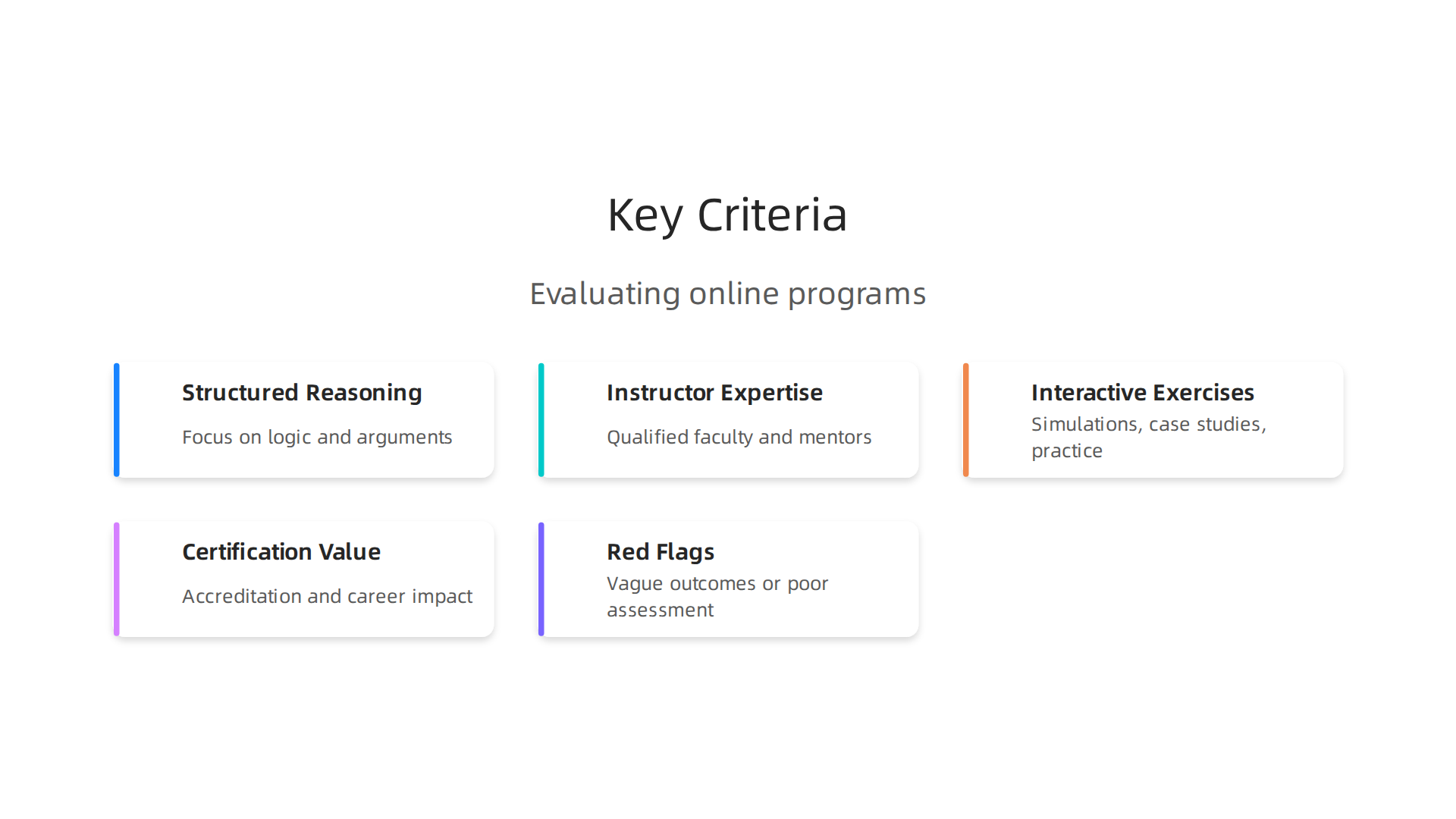
1. Focus on Structured Reasoning and Real-World Application
A top program does not just teach you theory. It helps you apply structured reasoning to actual business problems. Look for courses that include argument analysis, deductive thinking, and information literacy. For example, MIT’s Critical Thinking & Decision Making course covers these skills and asks you to evaluate real alternatives.

That kind of hands-on practice matters.
Programs that focus on business development scenarios are especially valuable. They teach you how to communicate with clients, optimize models, and make better decisions under pressure. Those are the skills that move your career forward.
2. Check Instructor Expertise and Content Quality
Who created the course? Look for instructors with real experience in critical thinking training. Universities like Cornell (through eCornell) and the American Management Association (AMA) offer programs led by experts. The eCornell Critical Thinking certificate is a great example. It was designed to help managers and executives think strategically.
Also check if the content is peer-reviewed or endorsed by reputable organizations. That is a strong signal of quality.
3. Interactive Exercises and Feedback Matter
You cannot learn critical thinking by just watching videos. You need to practice. Look for programs that include interactive exercises, case studies, and detailed feedback. Research shows that online courses need constant engagement and feedback to work well (see this PDF on critical thinking criteria for online discussion). Without that, you are just passively consuming information.
Platforms like Coursera offer courses with quizzes, discussions, and projects.
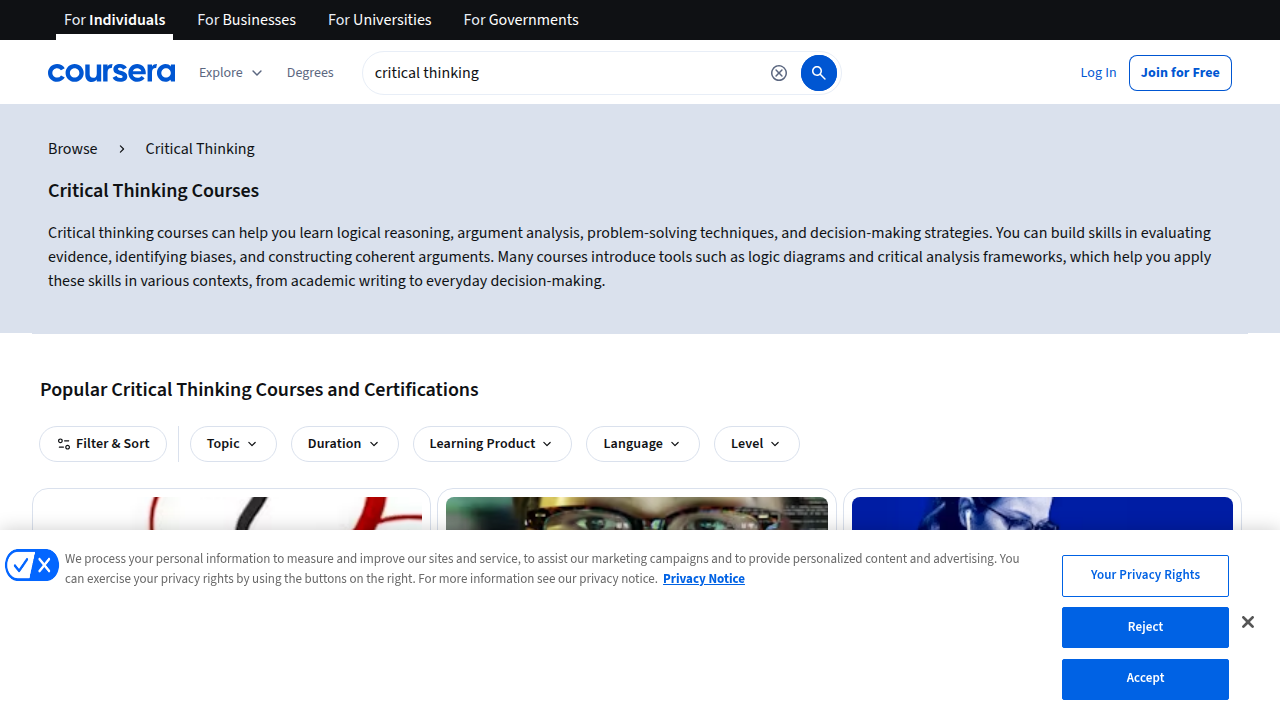
That kind of active learning helps you build real skills.
4. Certification That Adds Value
A certificate can help your resume stand out. But not all certificates carry the same weight. Look for programs that offer a credential from a known university or professional organization. AMA’s Critical Thinking Skills Training and eCornell’s certificate are both respected in the business world.
Avoid programs that just give you a generic PDF. You want proof of learning that employers recognize.
5. Avoid These Red Flags
- Rote memorization. If the course asks you to repeat definitions, skip it. You want to learn how to think, not what to think.
- No business context. Generic logic puzzles are fun, but they do not help you make better decisions at work.
- No instructor interaction. Self-paced is fine, but you should have access to feedback or Q&A.
If you are looking for a curated list of solid programs, check out The Best Online Learning Platforms for Critical Thinking in 2026. It can save you time.
Ready to Start?
Now you know what to look for. The next step is action. Pick a program that fits your schedule and start building your reasoning skills today. Most courses are available online and many are self-paced.
If you are serious about becoming a stronger thinker, Get Started with practical frameworks and exercises designed for business professionals.
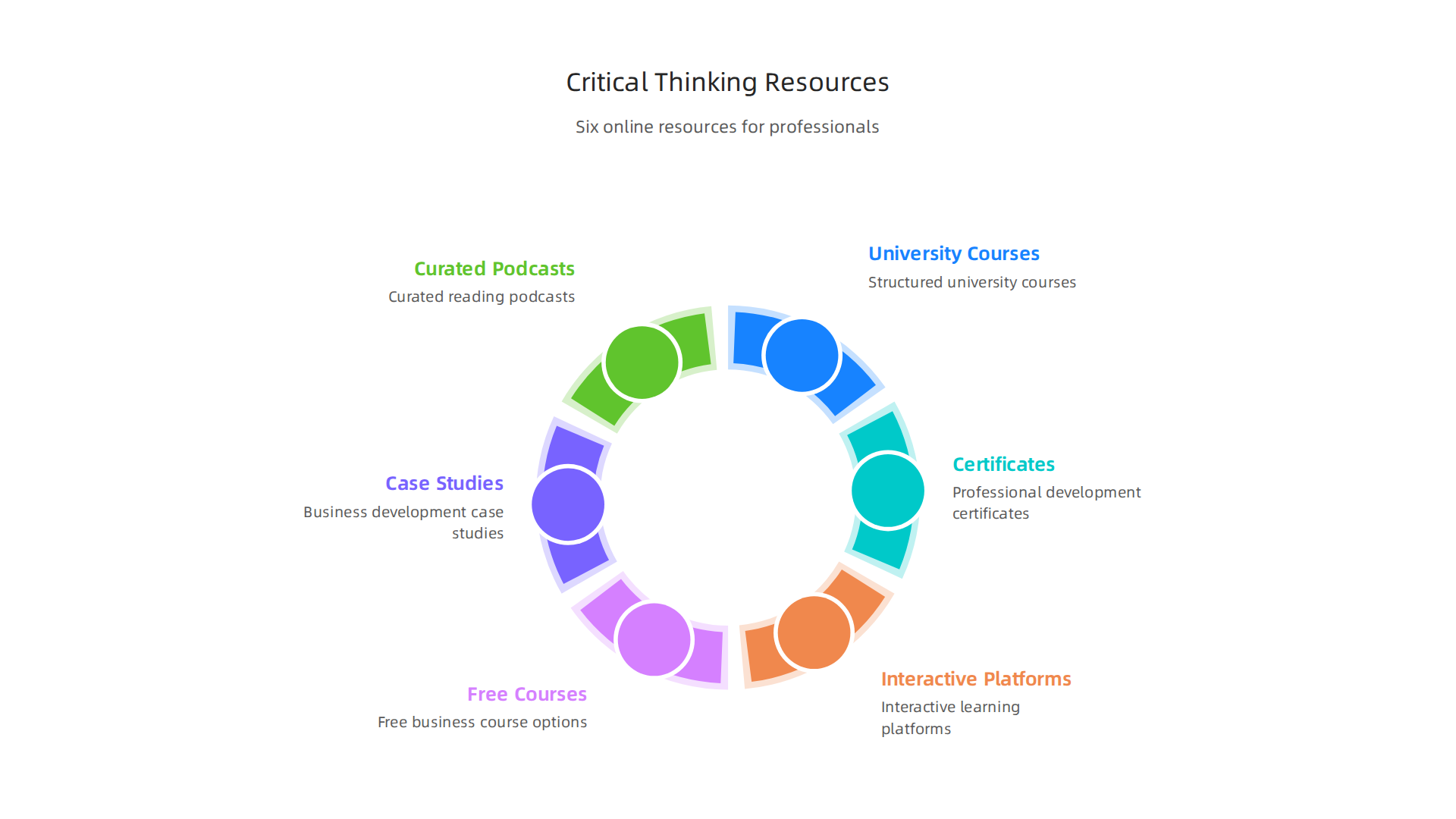
6 Types of Online Resources Every Business Professional Should Consider
Now that you know what separates a quality program from a time waster, you might be wondering exactly what kinds of resources are out there. You actually have more options today than ever before. Here are six types of online resources that every business professional should consider in 2026.
1. Structured University Courses
These are the gold standard. Programs from top universities give you a complete curriculum with real assignments and feedback. For example, MIT offers a Critical Thinking & Decision Making course that covers argument analysis and structured reasoning. Cornell’s eCornell certificate is built for managers and executives. These courses cost more, but they deliver deep, transferable skills.
2. Professional Development Certificates
If you want something shorter and more practical, look at professional organizations. The American Management Association runs a Critical Thinking Skills Training workshop ideal for managers and project leaders.
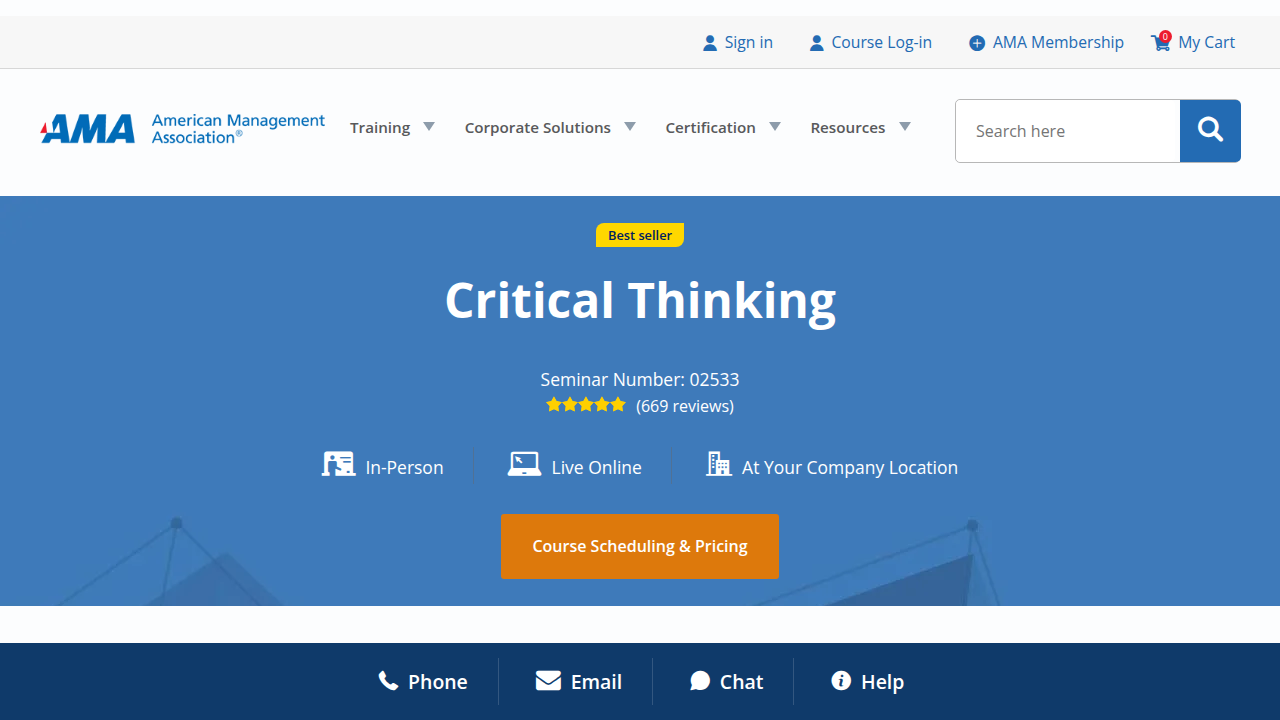
Learning Tree offers similar training with hands-on problem solving. These are great professional development courses that fit into a busy schedule.
3. Interactive Learning Platforms
You need to practice, not just watch. Platforms like Coursera offer courses with quizzes, projects, and peer discussions. Many are self-paced, and some are free. For a curated list of solid platforms, check out our roundup of the best online learning platforms for critical thinking. It includes both free and paid options.
4. Free Business Courses
Yes, you can start without spending a cent. Many universities and platforms offer free versions of their critical thinking courses. For example, Coursera’s “Introduction to Logic and Critical Thinking” from Duke University is free to audit. These free business courses are perfect for testing the waters before you invest.
5. Business Development Case Studies and Simulators
To apply your skills, use decision simulators and case competition platforms. These tools let you solve real business problems in a safe environment. They teach you to evaluate options and communicate with clients under pressure. This is where theory meets practice in business development.
6. Curated Reading, Podcasts, and Discussion Forums
Continuous learning matters. Subscribe to podcasts on reasoning and bias. Join forums where professionals debate business challenges. Read books and articles that challenge your assumptions. These resources keep your mind sharp between courses.
Your Next Step
You now have a clear picture of what’s available. The best approach is to pick one resource type that fits your current needs and start there. If you want to go deeper with practical frameworks and exercises designed for business professionals, Get Started with our structured content today.
Integrating Critical Thinking Training into Your Professional Development Plan
You now know what types of resources are out there. The next step is fitting them into your busy life as a business professional. A random course here or there will not stick. You need a real plan that builds lasting skills.
1. Set specific learning goals.
Start with a clear target. Do not just say "I want to think better." Say something more concrete.
For example, "I want to make better decisions during our weekly status meetings" or "I want to stop jumping to conclusions when I review data." This makes your learning relevant to your daily work. The Teaching Skills That Matter framework shows that adults learn best when they see a direct connection to their real lives and challenges.
2. Mix microlearning with deeper training.
Your brain needs variety to build strong habits. Microlearning fits easily into your schedule. Watch a short video on spotting bias while you eat breakfast. Take a quick quiz before bed. Then pair this with a longer workshop once a month. A workshop lets you dig deep into a hard problem with focused attention. Adult learning experts at Park University confirm that mixing short bursts with deep focus is one of the best ways to build lasting professional skills. This works even better when the training aligns with your daily job, using strategies that modern corporate training programs.
3. Apply what you learn right away.
Here is the most important step. Use your new skills immediately at work. Take a real challenge from your desk and work through it using a critical thinking framework. Practice is what turns abstract theory into a habit you can rely on. If you need a structured place to practice, check out our roundup of the best online learning platforms. It gives you great options for hands-on application.
Make learning a daily habit.
The professionals who grow the most are the ones who weave learning into their routine. They do not wait for a training day. They build small practices into every week. To build a daily practice of reasoning and self-trust, you can explore Dean Grey’s research on how authority shapes our decisions. Or you can Get Started with our step-by-step exercises and frameworks designed specifically for busy professionals like you.
Measuring ROI: How Critical Thinking Programs Drive Career and Business Outcomes
So you have built your learning plan and started practicing. The next question is natural. Does this really pay off? In 2026, the answer is a clear yes. And there are numbers to back it up.
Here is the reality. The skills gap is hurting businesses right now. A recent McKinsey survey found that only 30% of organizations have the skills they need for priority projects. Over one third of all businesses report trouble finding qualified candidates. This means that any business professional who invests in critical thinking instantly stands out from the crowd. They make decisions faster. They produce work with fewer mistakes. They analyze data more deeply. In fact, strategic and critical thinking is the number one skill for 2026 according to recent learning and development trends.
So what does this mean for your career? People who finish strong critical thinking programs report faster promotions and bigger project responsibilities.

Coached employees, for example, are 32% more likely to be engaged at work and five times less likely to leave. The same pattern holds for critical thinking training. When you think better, you lead better and you grow faster.
Now let us talk about measuring that return. Smart organizations do not guess. They use before and after assessments. They track actual performance metrics like decision speed, quality scores, and error rates. The modern approach to measuring training ROI looks at real business impact, not just test results. Companies around the world share their case studies to show how much critical thinking training saves and earns.
The bottom line is this. Critical thinking is not a soft skill. It is a hard investment with measurable returns. To find structured practice tools that help you track your own progress, check out our roundup of the best online learning platforms. Then Get Started with our step by step exercises designed for busy professionals like you.
Overcoming Barriers: Making Critical Thinking Stick
So you know critical thinking has real ROI. But here is the hard truth. Most business professionals never get past the first few weeks of practice. The three biggest barriers are time, missing feedback, and the challenge of using new skills in real situations.
Let us break those down and fix them.
First, time. You are busy. You have meetings, deadlines, and projects. Sitting down for an hour of deep thinking feels impossible. The fix is not to find more time. It is to integrate practice into your daily workflow. Use tools like the 7-step process from Asana to structure your regular decision making. Spend ten minutes each morning analyzing one email or one report with a critical lens. Small consistent habits beat large rare efforts.
Second, lack of immediate feedback. When you practice alone, you never know if you are getting better. Research shows that online courses should include detailed feedback and constant engagement to support different learning styles. The solution is peer learning groups. Find two or three colleagues who also want to grow. Meet weekly to share decisions you made and get honest input. This turns theory into real practice. For structured self-study, explore the best critical thinking courses available on Coursera that include peer evaluation.
Third, transferring skills to real situations. It is easy to think clearly in a training room but hard when a boss is pressuring you. The answer is spaced repetition. Review one core concept each day for a few minutes. Use real decisions from your work as your practice problems. Over time, your brain builds new habits. Manager buy in also matters a lot. When your supervisor supports your growth and encourages questioning, the learning sticks. A study by an academic researcher shows that adult learning theories are crucial for modern corporate training. Organizations that create a culture of curiosity see far better results.
The bottom line is clear. Overcoming these barriers is not about willpower. It is about smart strategies that fit your life. Start with one small change today. Use peer feedback. Practice in short bursts. And make your workplace reward deep thinking.
Ready to put these strategies into action? Get Started with practical frameworks, examples, and exercises designed for busy professionals like you.
The Future of Critical Thinking Education: Trends for 2026 and Beyond
Critical thinking training is changing fast. In 2026, new technology and shifting workplace demands are reshaping how you learn this essential skill. Whether you are a manager, team lead, or an individual professional, these three trends will affect your growth. Let’s look at what is coming.
AI powered adaptive learning
One size no longer fits all. AI powered platforms now personalize your practice exercises based on your skill gaps.

Instead of doing the same generic quiz as everyone else, the system adjusts difficulty and content to challenge you right where you need it. This makes learning faster and more effective. According to a 2026 report, e-learning is moving from a one size fits all model to experiences that are uniquely yours. For a busy business professional, this means you get more value in less time. You can also explore the best online learning platforms for critical thinking in 2026 to see which tools offer these adaptive features.
Virtual reality for immersive decision making
Imagine practicing a high stakes negotiation or a crisis response without any real consequences. That is exactly what VR simulations offer. You enter a virtual room, face a realistic problem, and must think on your feet. The experience feels real, so your brain treats it like a real situation. That builds better habits. Some experts describe how AI tutors and VR classrooms are creating personalized, immersive learning environments. This technology will soon be common in professional development courses.
Employers embed critical thinking into hiring and promotion
This might be the biggest shift. More companies are testing critical thinking skills during hiring and when deciding who gets promoted. They want proof that you can analyze data, question assumptions, and solve problems under pressure. According to the latest L&D trends report, strategic and critical thinking is the #1 skill companies are investing in for 2026. So taking your own growth seriously gives you a career edge. It also helps with business development, because better thinkers drive innovation.
These trends make one thing clear. The way we learn critical thinking is becoming smarter, more immersive, and more valued by employers. For any business professional, staying ahead means embracing these changes now.
Ready to build practical skills that work in the real world? Check out Dean Grey’s research for insights on how reasoning and trust shape decision making. Then take the next step. Get Started with exercises, examples, and frameworks designed for busy professionals like you.
Summary
This guide explains why critical thinking has become a top business imperative in 2026 and shows practical steps to close the skill gap. It covers the scale of the problem, what to look for when evaluating online programs, and the six types of learning resources that suit busy professionals. You’ll learn specific selection criteria—like real-world application, instructor credibility, interactive feedback, and meaningful certification—so you avoid time-wasting courses. The article also explains how to embed learning into a work routine, measure ROI with business metrics, and overcome common barriers like time and lack of feedback. Finally, it surveys emerging trends such as AI-adaptive learning and VR simulations that are reshaping professional development. After reading, you’ll be able to choose better training, build a practical learning plan, and start applying critical thinking on the job.