
Business Majors How to Pick the Right Path for Your Career

Choosing a college major is a big decision.

And if you are thinking about business majors, you are not alone. They are some of the most popular and versatile degrees you can earn. But here is the thing. With so many options like finance, marketing, management, and accounting, it is easy to feel lost. You might ask yourself, "Which path actually fits my goals?"
That is where critical thinking comes in. It is not just a nice skill to have. It is the foundation of business success. Whether you are analyzing market trends, deciding on a career, or planning your next move, clear thinking helps you make better choices. Many top programs, like those accredited by the AACSB, focus on building this skill. Only about 5% of business schools worldwide hold this special accreditation, which means they meet high standards for teaching and learning. You can learn more about what makes these programs different from others.
This guide will help you sort through the options. We will give you an evidence-based look at different business majors, explain how a business administration degree or a master of business administration can shape your career, and show you how to build the analytical skills employers want in 2026. We will also point you toward helpful resources like online courses for business management so you can start learning today.
Ready to think through your choices step by step? Get Started learning practical frameworks and exercises to apply critical thinking in school, work, and everyday decisions.
What Are Business Majors? An Overview of Popular Options
So, what exactly do business majors cover? It is a broad field, but most programs fall into a few clear categories. Think of them as specialties within the business world.
The main areas include accounting, finance, marketing, management, and supply chain management.
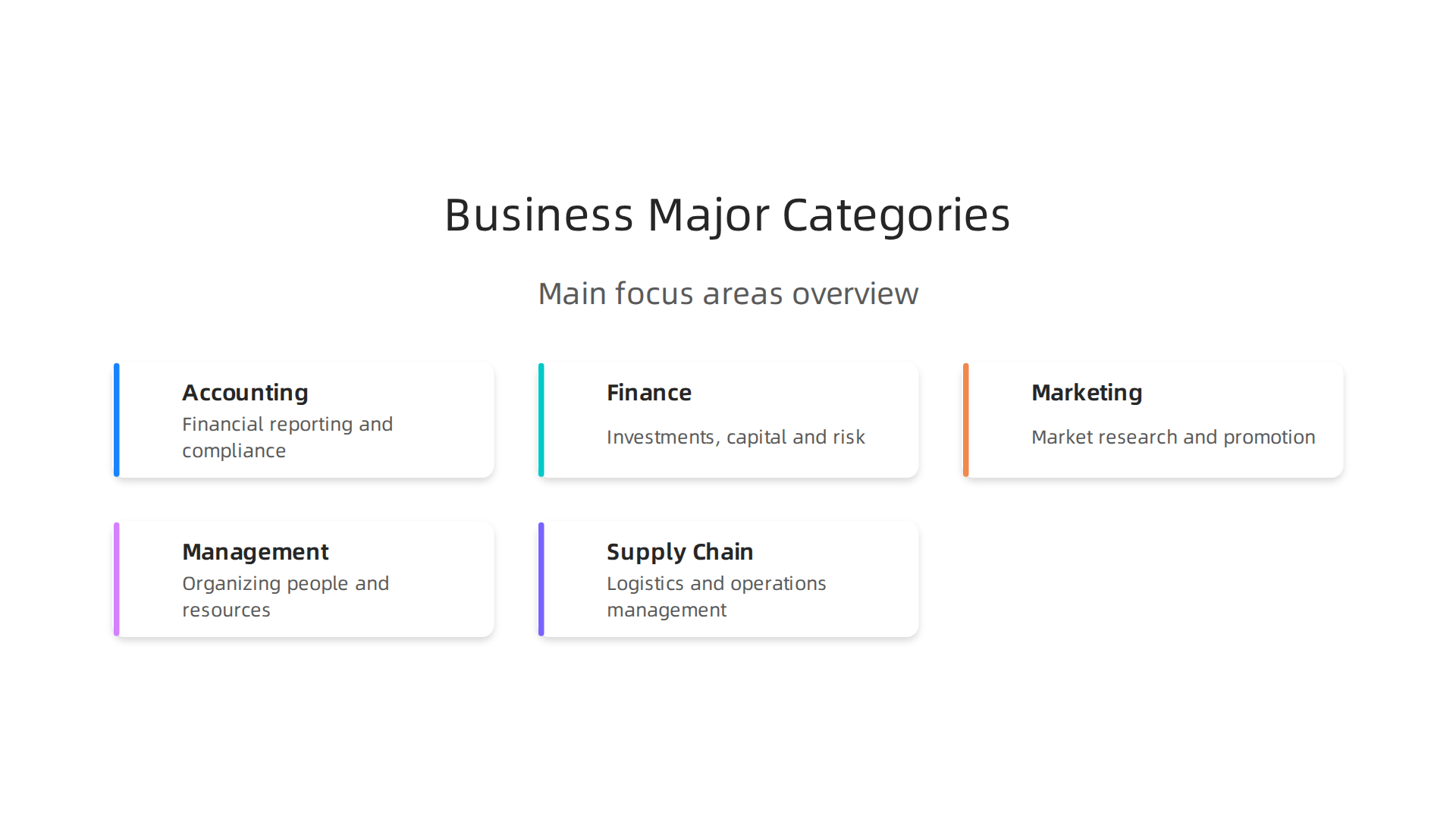
Each one focuses on a different piece of how a company runs. For example, accounting deals with tracking money and making sure numbers add up. Finance looks at investing, banking, and growing wealth. Marketing is all about understanding customers and promoting products. Management focuses on leading people and running operations. And supply chain management handles getting goods from point A to point B efficiently.
Most business administration degree programs start with a shared core curriculum. You will take classes in economics, statistics, ethics, and organizational behavior. These courses give you a strong foundation in how businesses work. Then you choose a specialization that matches your interests and career goals. This setup lets you explore multiple areas before deciding. The AACSB lists many common undergraduate business majors, including entrepreneurship, international business, and leadership, alongside the ones mentioned above.
Here is an important tip. When comparing programs, look for AACSB accreditation. This is a global standard that only about 5% of business schools worldwide meet, as explained in this Wikipedia article. Schools with this accreditation must meet rigorous quality standards in teaching, curriculum, and student learning. The AACSB itself is a globally recognized accrediting body that has been doing this work for almost 100 years, according to this overview from CollegeRaptor.
Choosing an AACSB-accredited program can give you a stronger education and a more respected degree.
If you want to build your critical thinking skills alongside your business knowledge, check out this guide on critical thinking for business professionals. It shows how to evaluate online programs and boost your career.
Ready to think through your options step by step? Get Started with practical frameworks and exercises to apply critical thinking in school, work, and everyday decisions.
Why Choose a Business Major? Skills, Careers, and Earnings
So why should you pick one of the business majors we just covered? There are three big reasons. You build skills that work in almost any job. You have strong earning potential. And the job market looks good for 2026 and beyond.
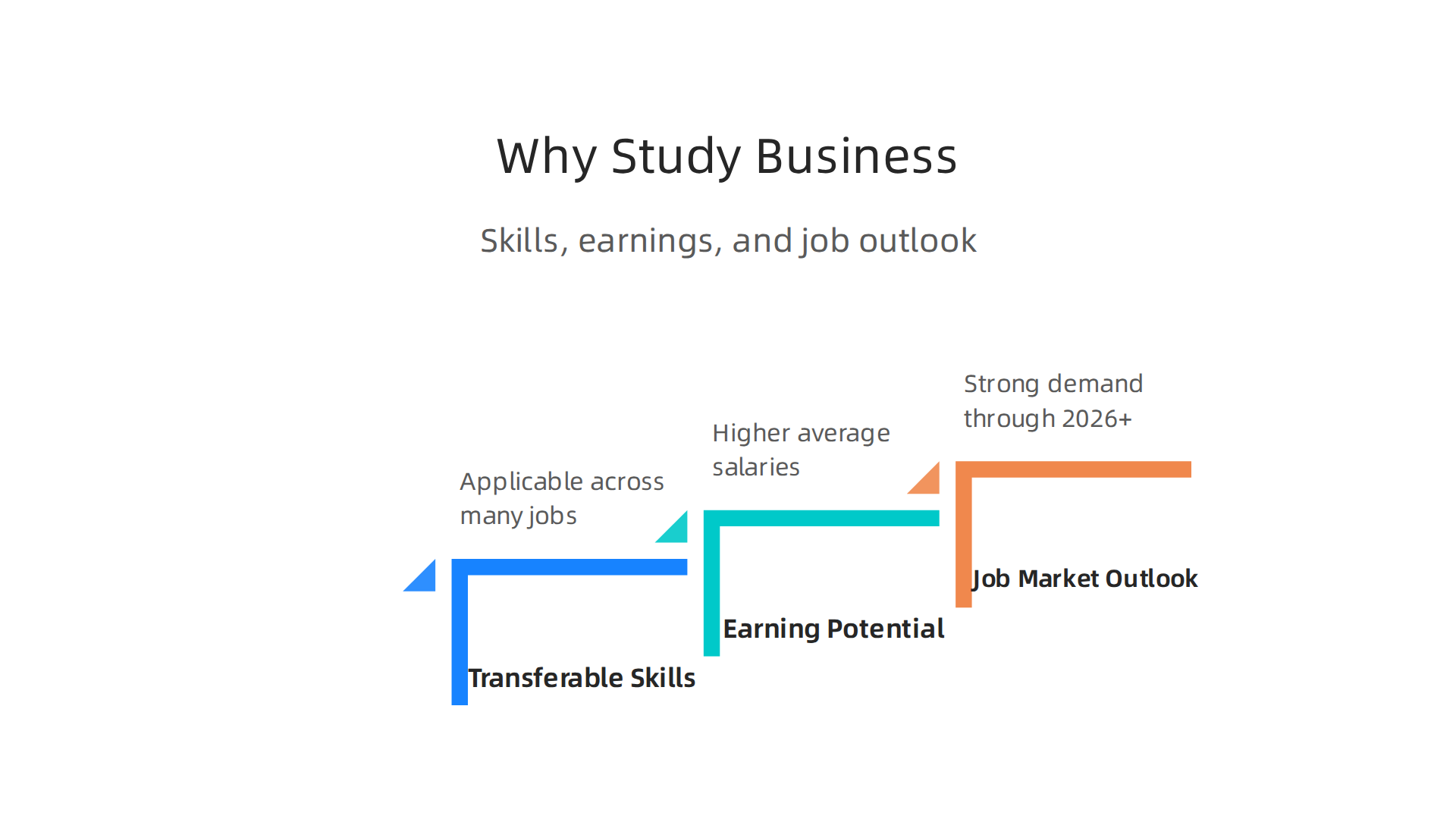
Let’s start with the skills. Business programs teach you things you can use everywhere. You learn data analysis, which means you can look at numbers and find patterns. You build leadership skills by working on team projects.

You practice negotiation in class simulations. And you develop strategic thinking, which is the ability to see the big picture and plan ahead. Employers want these skills badly. In fact, graduates with a business administration degree often find work in many different industries. One study found that 68% of business majors work in a different field within 10 years of graduation. That shows how flexible the degree really is.
Now let’s talk about money. The numbers look good across the board. According to the U.S. Bureau of Labor Statistics, the median annual wage for business degree holders was $75,000 in 2023.
That is higher than the median for all occupations. Some sources show even more. The BLS reports that business and financial occupations had a median salary of $80,920 in 2024. And for the Class of 2026, starting salaries keep going up. The National Association of Colleges and Employers says starting salary projections for business graduates this year are higher than last year. Employers are also planning a 1.6% increase in hiring for the Class of 2026 compared to the Class of 2025. That is good news if you are graduating soon.
But outcomes do vary by major. Here is a quick look:
| Major Type | Typical Starting Salaries (2026 Projection) | Common Career Paths |
|---|---|---|
| Finance & Accounting | Higher starting offers | Banking, investment, auditing |
| Marketing & Management | Moderate starting offers | Brand management, sales, operations |
| Supply Chain | Competitive offers | Logistics, procurement |
Finance and accounting often lead to higher starting pay. But marketing and management give you more options. You can switch industries more easily.
The Bureau of Labor Statistics projects strong demand for business and financial occupations through 2030. That means companies will keep hiring people with these skills. The world always needs leaders, number crunchers, and strategic thinkers.
If you want to make smart choices about your education and career, strong thinking skills will help you. Check out this guide on critical thinking for business professionals to learn how to evaluate your options with confidence.
Ready to start making better decisions about your future? Get Started today and learn practical frameworks to apply critical thinking in school, work, and everyday life.
How to Select the Right Business Major for Your Goals
You have seen the job numbers and the salary projections. You know a business administration degree can open many doors. But now comes the hard part. Which business majors should you actually pick? That is a tough call. And it is easy to make the wrong choice if you let your brain play tricks on you.
Here is the thing. Our minds have shortcuts that can steer us wrong. Research shows that cognitive biases, like confirmation bias or anchoring, can quietly push us toward bad decisions. One study explains how these biases affect strategic choices in business and in your own career planning. So the first step is to slow down and get honest with yourself.
Step one: Look inward first. What are you naturally good at? What kind of work actually excites you? Do not just go with the major your friends are picking. Use tools like the Strong Interest Inventory or Myers-Briggs Type Indicator. These can help you see patterns in your strengths that you might miss on your own. They give you a clearer picture of where you fit.
Step two: Research programs the right way. Not all business schools are the same. You need to dig deeper than the brochure. Look at internship placement rates. Check the alumni network to see where graduates end up. Ask about career support for your specific major. Some schools have strong connections in finance but weak ones in marketing. Learn the difference. For help evaluating how programs compare to one another, check out this practical guide on choosing an online university.
Step three: Think about mixed majors. Do not feel locked into a single box. Interdisciplinary options blend different skills. Business analytics mixes data with strategy. Entrepreneurship combines creativity with management. And some programs now offer business management courses online so you can tailor your learning to your goals.
Cognitive biases can trick you into thinking a major is right just because it is popular. But the right major matches who you are and what you want.
Ready to make a clearer decision? Clear thinking needs self-trust under pressure. Start learning practical frameworks to apply better reasoning in your school and career choices today.
Integrating Critical Thinking into Business Education
You have just learned how to pick a business major with a clearer head. But here is the thing. Choosing the right major is only half the battle. You also need to know how your future classes will actually teach you to think. The good news is that business schools are finally making critical thinking a core part of the curriculum.
Gone are the days when you could just memorize formulas and pass. In 2026, top programs use case studies, business simulations, and debate-based learning to push you past memorization.

One framework that many schools follow is Bloom’s Taxonomy. This model helps professors design assignments that go beyond recall. You move up to applying, analyzing, and creating. Another common framework is the Paul-Elder model, which focuses on elements of thought like purpose, question, information, and assumptions. A recent study on critical thinking frameworks across business curriculums shows that management students must actively practice these skills to develop real analytical power.
Schools are also embedding systems thinking into their courses. According to AACSB, leaders in business education are introducing joint teaching sessions and aligning assessments to help students see the big picture. This matters because business problems are rarely simple. You need to connect the dots between finance, marketing, operations, and human behavior.
Research backs this up. One study found that explicit instruction in logical reasoning and bias awareness actually improves decision-making in business contexts. That means you are not just learning theory. You are training your brain to spot cognitive errors before they cost your future company money.
The best part? These skills stick with you. When you evaluate a job offer or launch a side project, you will use the same frameworks you practiced in class. If you want to see how this plays out in real career decisions, check out this guide on critical thinking for business professionals.
Here is the bottom line. Picking the right major is step one. But building strong reasoning skills during your degree is what will set you apart. Ready to start applying these frameworks today?
Get Started with practical exercises that sharpen your thinking for school, work, and everyday life.
Overcoming Key Challenges with Critical Thinking Skills
So you are sitting in class, and the professor throws out a statistic. Sounds convincing, right? But wait. Where did that number come from? Who published it? And is it even relevant to the case you are discussing?
This is the reality of studying business majors in 2026. You are swimming in information. Data sets. News articles. Social media trends. Executive summaries. The challenge is not finding information. The challenge is knowing what to trust.
Here is the thing. Information overload and misinformation are real problems. But business schools are fighting back. They are teaching you how to evaluate source credibility. One key method is triangulation, where you compare multiple independent sources before accepting a claim as true. You also learn to ask simple questions like: Who funded this study? What is the author’s bias? Does the evidence actually support the conclusion? These skills help you cut through the noise and focus on what matters.
Beating Your Own Brain
But even with good sources, your own mind can trick you. Cognitive biases like confirmation bias, where you only look for evidence that supports what you already believe, and overconfidence, where you think you are right when you are not, can lead to terrible decisions. Research shows that cognitive biases hurt decision-making and organizational performance in management.
So what can you do? Structured decision-making models help. One popular framework is PROACT, which stands for Problem, Objectives, Alternatives, Consequences, and Trade-offs. This keeps you honest. It forces you to consider options you might otherwise ignore. If you want to go deeper, check out Dean Grey’s research on how information overload can weaken judgment and what to do about it.
Learning from Failure
Maybe the most powerful way to learn critical thinking is by studying business failures. Think about Enron. The leaders ignored red flags. They convinced themselves the numbers were fine. Or Kodak. They invented the digital camera but refused to believe it would replace film. Confirmation bias killed them.
When you study these cases in your business management courses, you see the real cost of weak thinking. It is not just a bad grade. It is lost jobs, lost savings, and lost companies. The AACSB global standards for business education emphasize that curriculum must balance disciplinary depth with critical thinking so you avoid these mistakes.
Here is the bottom line. Learning to overcome information overload and fight your own biases is what separates a good business major from a great one. These skills will protect you long after graduation.
Ready to start training your brain today?
Get Started with practical exercises that sharpen your thinking for school, work, and everyday life.
The Future of Business Education in 2026
Business education is changing fast. If you are a business major in 2026, the way you learn looks very different than it did just a few years ago. Schools are adapting to what employers actually want. And that is good news for you.
Online and hybrid programs keep growing
More universities now offer flexible formats. You can earn a business administration degree through fully online programs or hybrid models that mix in-person and virtual classes.

Many schools also offer stackable credentials. You take a short course, earn a micro-credential, and then stack them toward a full degree. This makes it easier to fit learning into a busy life.
Employers like this too. They see that online courses for business management teach you discipline and digital skills. If you are comparing options, check out our guide on how to choose an online university for working adults that delivers results.
AI and data analytics reshape the curriculum
Artificial intelligence is not just a tech trend anymore. It is changing every part of business. In 2026, top business management courses include modules on AI ethics, machine learning for business, and data-driven decision making. You learn to question the outputs of algorithms, not just trust them.
This is where critical thinking becomes essential again. You need to evaluate whether a model’s recommendation is biased or incomplete. As behavioral scientist Dean Grey’s research explains, information overload can weaken judgment, so you must consciously verify data sources.
Employers want real-world experience
Classroom theory is not enough. Employers now value experiential learning. Internships, capstone projects, and global immersion programs give you hands-on practice. A recent NACE report shows employers are projecting a 1.6% increase in hiring for the Class of 2026 compared to last year. They want graduates who have already solved real problems.
The takeaway? The future of business education is practical, tech-savvy, and flexible. Whether you pursue a master of business administration or start with a bachelor’s, look for programs that combine strong analytics with critical thinking training.
Ready to build these skills? Get Started with practical exercises that sharpen your thinking for school, work, and everyday life.
Resources for Business Students and Professionals
Now that you see where business education is heading in 2026, it’s time to get your hands on the tools that will actually help you grow. Whether you are a current business major or a working professional, these resources can fill in the gaps your program might leave behind.
Free online courses to build your skills
You do not need to spend a lot of money to learn business fundamentals. Platforms like Coursera, edX, and LinkedIn Learning offer free courses in everything from finance to marketing.
Many of these courses now include modules on AI and data analysis, which are must-haves for any business management course in 2026.
What is great about these platforms? You can learn at your own pace. You can also earn certificates to add to your resume. For a full list of trusted sites, check out our roundup of the best online learning platforms for critical thinking in 2026. These platforms help you think more clearly, not just memorize facts.
Professional organizations for networking and growth
Getting involved with professional groups is one of the smartest moves you can make. Organizations like the American Management Association (AMA), the Society for Human Resource Management (SHRM), and the American Institute of CPAs (AICPA) offer certifications that carry real weight with employers.
These groups also give you access to networking events, industry reports, and continuing education. They keep you updated on trends like hybrid leadership and corporate purpose, which are central to modern business education according to experts at WU Executive Academy. The connections you make here can lead to internships and jobs after you earn your business administration degree or master of business administration.
Critical thinking tools to sharpen your mind
Employers want graduates who can evaluate complex problems and make sound decisions. That is where critical thinking tools come in. Assessments like the Watson-Glaser Critical Thinking Appraisal let you measure your current skills and find areas to improve.
But tools alone are not enough. You also need to understand how your own mind works. Dean Grey’s research shows that information overload can weaken your judgment, so it helps to practice focusing on the quality of information, not just the quantity. This kind of awareness sets you apart from other business majors.
If you want a structured way to build these skills, Get Started with practical exercises designed for today’s business environment.
Summary
This article helps students and professionals choose and succeed in business majors by combining career data with practical decision tools. It explains the most common specializations—accounting, finance, marketing, management, and supply chain—and how shared core curricula and AACSB accreditation shape program quality. The guide reviews earnings and hiring trends, highlights why business degrees remain flexible and valuable, and shows how to evaluate programs beyond marketing claims. A strong emphasis is placed on building critical thinking through case studies, simulations, and explicit frameworks to counter cognitive biases and information overload. You’ll learn step-by-step how to assess your strengths, research programs effectively, and use structured models to make better choices. The article also previews how AI, analytics, online formats, and experiential learning are reshaping business education in 2026 and points to free courses and professional groups to keep improving after graduation.