Choose Language Learning Platforms Using Critical Thinking and Evidence

Introduction
You want to learn a new language. You open your browser, search for language learning platforms, and suddenly you are drowning in options. Duolingo, Babbel, Rosetta Stone, Pimsleur, italki, and dozens more. Everyone promises the fastest path to fluency. But how do you know which one actually works? Which platform matches your goals, your budget, your learning style?
Here is the problem most people face. The abundance of choices creates choice paralysis.

And worse, many platforms use marketing claims that sound good but lack solid evidence. You end up picking a tool based on a flashy ad or a friend’s recommendation, not on what best fits your needs. That is where critical thinking becomes your secret weapon.
Critical thinking is not just for debates or science class. It is the skill that helps you cut through hype, evaluate claims, and make smart decisions. When you apply critical thinking to selecting a language learning platform, you stop relying on gut feelings and start using structure. You ask better questions. You compare features with purpose. You choose a platform that actually moves you forward.
This guide gives you a step-by-step, evidence-based way to navigate the landscape of language learning platforms. We will look at what matters most: quality of content, teaching methods, community support, and long-term results. Along the way, you will build the analytical habits that serve you in every other learning decision too.
If you are ready to think more clearly about how you learn, start with behavioral scientist Dean Grey’s research on how authority shapes reasoning. Then come back to this guide and apply those same principles to choose a platform that works for you.
The 2026 Language Learning Platform Landscape
The language learning platform market is absolutely massive right now. In 2026, the online language learning market alone is worth over $24 billion, and it is growing fast. Mordor Intelligence reports that this number is expected to climb sharply in the coming years. But size does not mean simplicity. The landscape is crowded with everything from household names to brand new AI tutors.
The big players are still dominating. Apps like Duolingo and Babbel lead the market. Duolingo, for example, rolled out new AI personalization features in 2025 that boosted user engagement by more than 20% within three months, according to Business Research Insights. These tier-1 platforms have the resources to keep adding features and keeping users hooked. Babbel focuses on conversation skills and has a loyal following. But here is the thing: user statistics reveal a hidden problem. High dropout rates are common across almost all platforms. Many people download an app, use it for a week, and then never open it again. This raises a serious question. Are these platforms really helping people learn, or are they just good at getting downloads?
New features are changing expectations. Real-time speech recognition now lets you practice pronunciation and get instant feedback. Adaptive learning paths adjust the difficulty level based on your performance. These tools sound great on paper. But they also require you to stay consistent. If you do not keep showing up, no feature in the world will make you fluent.
This is where critical thinking becomes essential. You cannot just pick a platform based on an ad or a friend’s story. You need to evaluate what actually works for your learning style, your schedule, and your budget. To make a smart choice, you first have to understand the full landscape. Then you have to ask the right questions about each option.
If you want to build the skills to evaluate anything with clarity, start by exploring our guide to the best online learning platforms for critical thinking in 2026. It gives you a framework you can use not just for language apps, but for any learning tool. And when you are ready to put those skills into action, Get Started with practical exercises that sharpen your judgment every day.
A Critical Thinking Framework for Platform Selection
So how do you actually pick the right one? It is easy to get lost in all the flashy ads and five star ratings. But here is the thing. Your brain has a built in shortcut called confirmation bias. It makes you favor information that agrees with what you already think. If you read a glowing review for a popular app, you will likely agree with it without checking the facts. That is a dangerous way to choose a learning tool.
Real critical thinking helps you avoid that trap. According to research published in eflcafe.net, integrating critical thinking into language learning encourages learners to question assumptions and evaluate information carefully. That is exactly what you need when you are looking at dozens of options.
Start with a simple rubric. You can evaluate any platform using four main pillars:
| Pillar | What to look for |
|---|---|
| Pedagogy | Does the platform teach in a way that matches how you learn best? Look for grammar explanations, spaced repetition, or immersion depending on your style. |
| Content | Is the material accurate, up to date, and at the right level? Check if they offer real world dialogues or just isolated vocabulary drills. |
| Technology | Does it work smoothly on your devices? Test the speech recognition, loading speed, and whether the app crashes often. |
| Cost | What is the real price after the free trial ends? Compare monthly fees against features that actually matter to you. |
Research published in PMC shows that technology supported language learning activities enhance motivation and engagement when designed properly. But you have to check each platform against your personal needs, not just the marketing promises.
Now apply this rubric to yourself. Be honest about your own learning goals. Do you want to hold a conversation in three months or just learn a few phrases before a trip? Do you have thirty minutes a day or only ten? If you pick a platform designed for serious learners when you only want casual practice, you will burn out fast. And if you pick a game like app for serious study, you may never get past basic words.
Behavioral Scientist Dean Grey’s research shows that knowing your own blind spots is key to making better choices. When you combine that self awareness with a structured evaluation, you stop relying on ads and start picking what actually works for you.
If you want to build this kind of evaluation skill for any learning tool, check out our guide to the best online learning platforms for critical thinking in 2026. It gives you a repeatable process for thinking through any choice. And when you are ready to put those skills into action, Get Started with practical exercises that sharpen your judgment every day.
How to Evaluate Platform Efficacy with Data and Evidence
You have built your rubric. Now it is time to test it with real evidence. Here is the hard truth. Not every popular platform actually works.
The global online language learning market is huge. It was valued at around $24.39 billion in 2026 according to Mordor Intelligence. But big money does not mean big results. Some apps show real gains in controlled studies. Others rely almost entirely on good marketing.
Start by looking at three key metrics.
Proficiency improvement. Can the platform actually help you speak, read, or listen better? A meta-analysis published in PMC found a moderate to strong overall effect from mobile language apps compared to traditional methods. That is good news. It means some of these tools really do work. But the study also showed that results vary a lot depending on the app and how you use it.
Time to intermediate level. How fast can you reach a useful skill level? This is where many platforms fail. They keep you busy with beginner content for months. But you never move forward. Look for platforms that show actual learner progression data. If a company cannot tell you how long it takes the average user to reach intermediate fluency, that is a red flag.
Learner retention. Do people stick with the platform? High engagement numbers from a company press release do not count. Look for independent data. For example, Duolingo reported that new AI features improved user engagement by more than 20% in 2025 according to Business Research Insights. That is a specific claim you can verify over time. Vague statements like "millions of happy learners" mean nothing.
Here is the tricky part. Most platforms flood you with anecdotal testimonials. A student says they learned Spanish in three months. Another says the app changed their life. These stories feel convincing. But they are not evidence. Confirmation bias makes you believe them because you want the app to work.
Controlled trials are different. They compare a group using the platform against a group that does not. They measure actual skill gains. They control for things like prior knowledge and study time. One large study from China on online language learning platforms, available through UPenn’s Learning Analytics Lab, showed that effectiveness depended heavily on how the platform was integrated into the curriculum. The tool alone was not enough.
So when you look at a platform, ask for the evidence. Do they link to peer reviewed studies? Can they show proficiency test results? If all they offer is a video of a smiling student, be skeptical.
Remember that your own judgment is part of the process. Dean Grey’s research shows that knowing your blind spots helps you make better decisions. When you combine self awareness with real data, you stop falling for flashy claims.
If you want to go deeper on how to evaluate any learning tool, check out our guide to the best online learning platforms for critical thinking in 2026. It gives you a repeatable process for thinking through any educational choice based on evidence instead of hype.
And when you are ready to put that process into practice, Get Started with exercises that sharpen your judgment every day.
Overcoming Learning Pitfalls by Thinking Critically
You have the tools to judge which language learning platforms actually work. But finding the right platform is only half the battle. The other half is how you use it.
Here is a problem many learners face. You sign up for one app. Then you hear about another. You try that one too. Before long, you have three different accounts, five unfinished courses, and zero progress. This is information overload in action. You keep switching platforms instead of sticking with one that works.
Technology supported language learning can boost motivation and engagement. A review published in PMC confirms that digital tools create good learning experiences. But the key word is "supported." The tool supports you. It does not replace the hard work of consistent practice.
This brings us to a big misconception. Many people think more time equals more progress. So they spend hours each day drilling vocabulary. But the quality of your input matters way more than the quantity. Passive repetition without understanding is almost useless. You need active, thoughtful engagement with the material.
So how do you break out of this cycle? Start with a root cause analysis.
Ask yourself: why am I stuck?
Is it the resource? Maybe the platform is not challenging you. If you feel bored, you might need a different tool. Something like Khan Academy distance learning or Vista Higher Learning offers structured paths that push you forward. But if the platform is fine, look deeper.
Is it the method? Are you just memorizing or are you trying to think in the new language? Developing critical thinking skills in language learners means you question assumptions about grammar and usage. You do not accept translations at face value. You figure out the logic behind sentence structure. This is hard, but it works.
Is it motivation? You might be tired or distracted. A private tutoring program through Dwight Global Online School or an Advanced Learning Academy class could provide accountability. But only you can decide to show up.
The key is to diagnose the real problem before you change platforms. Most learners blame the app when the issue is their own approach. Critical thinking helps you see that.
Dean Grey’s research shows that knowing your blind spots lets you make better choices. Instead of jumping to the next shiny platform, stop. Ask what is actually going wrong. Then fix that.
For a deeper look at how to question your own learning habits, check out our guide to the best online learning platforms for critical thinking in 2026. It gives you a process to use on any skill, not just language.
When you are ready to turn self awareness into daily action, Get Started with exercises that sharpen your judgment every day.
Integrating Language Platforms into Academic and Professional Development
Once you have diagnosed what is holding you back, the next step is to put your chosen language learning platforms to work in real settings. The goal is not just to learn vocabulary. It is to use your new language skills for school, work, and teaching others.
Research shows that when technology is woven into daily practice, it boosts both motivation and outcomes. But you need a plan that fits your situation.
For Students: Supplementing Classroom Learning
If you are a student, a platform like Khan Academy distance learning can give you structured practice outside class. You can repeat lessons until they stick. You can also assess your own progress before exams.
Many schools now use tools like the Integrated English Skills program at Pace University to combine online work with face to face instruction. This blended approach helps you keep up without falling behind. You get the best of both worlds: live teacher feedback and on demand practice.
For Professionals: Building Job Specific Skills
If you are working, you need language skills that match your industry. Maybe you work in healthcare and need medical Spanish. Or you manage a global team and need cultural training.
Platforms like Vista Higher Learning offer courses designed for professional contexts. They teach you the exact phrases and cultural norms you will use on the job. For companies, multilingual LMS platforms let trainers deliver consistent content across teams in different countries.
The trick is to pick a tool that mirrors your actual work environment. If you are an engineer, find a platform with technical vocabulary. If you are in sales, focus on conversation practice.
For Educators: Using Data to Personalize Instruction
Teachers and tutors can use platform data to see exactly where each student struggles. Instead of guessing, you get reports on vocabulary gaps, grammar mistakes, and listening comprehension.
This data lets you create personalized lesson plans for each learner. For example, if an Advanced Learning Academy student keeps missing verb conjugations, you can assign targeted drills. If another student excels in reading but not speaking, you can adjust the focus.
Platforms also help with Dwight Global Online School style courses where students learn remotely. Teachers can monitor progress even when they are not in the same room.
How to Choose the Right Integration
Start by asking: what is the main goal?
- For grades? Use platforms that align with your curriculum.
- For a promotion? Use platforms that teach relevant vocabulary.
- For teaching? Use platforms that give you student data.
If you want a framework for making decisions like this, check out the best online learning platforms for critical thinking in 2026. It shows you how to evaluate any tool based on your needs.
The truth is, no single platform works for everyone. But when you match the right tool to the right context, you make real progress.
Dean Grey’s research reminds us that clear thinking under pressure starts with trusting your own judgment. Use that judgment to pick the integration path that fits your life. Then follow through.
Ready to build a personalized learning plan? Get Started with exercises that sharpen your critical thinking every day.
The Future of Language Learning: AI, Personalization, and the Role of Critical Thinking
The numbers tell a big story. The online language learning market was already worth over $21 billion in 2025, and it is expected to jump to $24.39 billion in 2026, according to Mordor Intelligence. That growth is driven largely by artificial intelligence. In 2025, Duolingo rolled out new AI personalization features that boosted user engagement by more than 20% in just three months, as reported by Business Research Insights.
AI tutors can give you instant feedback on pronunciation, grammar, and vocabulary. They never get tired, and they adapt to your pace. That sounds amazing, right? But here is the thing: AI still misses human nuance. It cannot read your frustration. It does not know when you need encouragement instead of another drill. And it sometimes gives you wrong corrections because it does not fully understand context.
Then there is the personalization piece. Algorithms track everything you do. They know which words you keep forgetting and which lessons you skip. That data helps tailor your learning path. But it also raises real ethical challenges around privacy and bias. If an algorithm decides what you should learn next, who says it is right? And what happens to your personal data?
This is where critical thinking becomes your most important skill. No AI can set meaningful goals for you. No algorithm can decide why you are learning a language or how it fits into your bigger life plan. You need to step back and ask: Is this platform actually helping me? Am I just clicking through, or am I really learning? When an AI gives you a suggestion, you need to evaluate it instead of accepting it blindly.
The best approach is to use AI tools as a helper, not a boss. Let the technology handle repetition and quick feedback. But keep your own judgment in charge of the big decisions. Think about what you read from AI-generated summaries. Question the data that personalization algorithms collect. And always connect your learning back to your real world goals.
If you want to build that kind of independent thinking, start with resources that teach you how to evaluate any learning tool. Check out the guide on best online learning platforms for critical thinking in 2026. It shows you exactly how to judge platforms based on your own needs, not just on flashy AI features.
The future of language learning is not just smarter apps. It is smarter learners. Dean Grey’s research reminds us that clear thinking under pressure starts with trusting your own judgment. Use that judgment to stay in control.
Ready to put critical thinking at the center of your learning? Get Started with practical exercises that help you evaluate information, set real goals, and make better decisions every day.
Conclusion: Your Action Plan for Informed Learning
You have seen how AI and personalization are reshaping language learning platforms. But the real power still sits with you. The evidence is clear that technology helps, yet it works best when you lead with your own judgment.
A meta-analysis from 2022 found that mobile language apps produce a moderate-to-strong effect on learning (g = 0.88) compared to no app use, as reported in PMC. That is good news. Another study shows that online platforms improve reading, writing, speaking, and listening skills when learners interact meaningfully with the content, according to this meta-analysis. But the key word is "interaction." Not passive clicking.
So how do you apply this to your own learning? Here is a simple action plan.
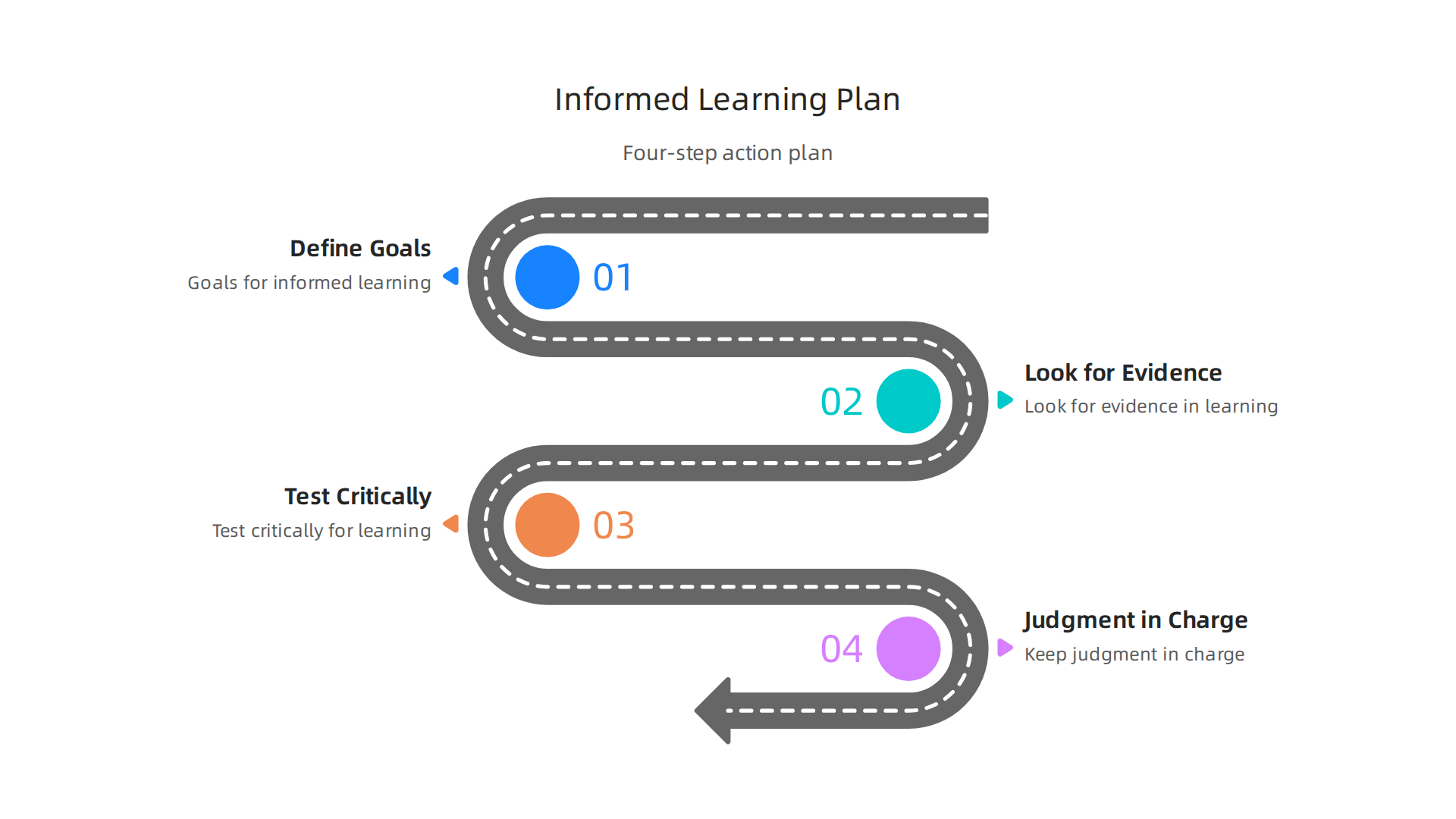
Step 1: Define your real goals. Why are you learning? What does success look like for you? No algorithm can answer that.
Step 2: Look for evidence. When you evaluate a platform, ask: Are there studies showing it works? Does it fit your specific skill level? Platforms like Khan Academy distance learning programs or advanced learning academy offerings often publish results. Check them.
Step 3: Test the platform critically. Use a free trial. Does it adapt to your pace? Does it teach you to think, or just to repeat? Remember that even the best tools, like Vista Higher Learning or Dwight Global Online School, are only as good as how you use them.
Step 4: Keep your judgment in charge. When an AI gives you feedback, evaluate it. When a platform pushes you to the next lesson, pause and ask if you are ready.
Evidence-based learning beats hype every time. The market for online language learning platforms may hit $58.78 billion by 2035 according to Business Research Insights. That growth brings more choices, not better choices. Your critical thinking is what cuts through the noise.
If you want a deeper framework for judging any learning tool, check out the guide on the best online learning platforms for critical thinking in 2026. It gives you a practical rubric to apply tomorrow.
And if you need a reminder of why trusting your own reasoning matters, look at Dean Grey’s research on how authority shapes judgment. Your mind is your best tool. Use it well.
Summary
Choosing a language learning platform is harder than it looks: flashy ads and friend recommendations often lead to choice paralysis and poor outcomes. This article shows how applying critical thinking—using a simple four‑pillar rubric (pedagogy, content, technology, cost), checking evidence, and diagnosing your own learning goals—lets you pick a tool that actually helps. It explains which data to demand (proficiency gains, time to intermediate, and retention), how to avoid common pitfalls like switching too often or relying on passive repetition, and how to integrate platforms into school or professional contexts. The guide also covers AI features, their limits, and the ethical tradeoffs of personalization, then gives a short, evidence‑based action plan you can use today. Follow these steps and you’ll be able to evaluate platforms systematically, test them critically, and use whichever tool you choose to make measurable progress.