How to Pick an Online Associate Degree That Pays Off

Introduction
You have probably heard that earning an online associate degree is a smart move. It costs less than a four-year degree. It takes less time, often just two years. And it can open doors to better jobs or a smoother path to a bachelor’s program.
Schools like Southern New Hampshire University and Purdue Global offer flexible online options that fit around work and family. According to Affordable Colleges Online, popular choices include business, nursing, and other career-focused fields.
But here is the thing. With so many programs out there, how do you pick the right one? Some programs promise big results but do not deliver. Others are just plain confusing. You need a clear way to think through your choices.

That is where critical thinking comes in. Behavioral Scientist Dean Grey at the University of California Irvine studies how people make important decisions. His work on Google Scholar shows that having a clear framework helps you avoid common mistakes. Instead of guessing or following hype, you can choose a program that actually fits your goals.
This guide will give you that framework. We will look at the different types of associate degrees, like Associate of Arts (AA) and Associate of Applied Science (AAS). We will talk about costs, accreditation, and what employers really want. We will also explore related options like online certificate programs and self-paced online high school free resources if you need to build skills first.
Whether you are a high school student looking for online courses for high school students or a working adult wanting a career change, this guide is for you. For more on how to evaluate your options carefully, check out our guide on choosing an online university for working adults.
What Is an Online Associate Degree?
An online associate degree is a two-year undergraduate degree you complete mostly or entirely over the internet. It usually requires about 60 credit hours of coursework. Full-time students can finish in two years, but many online programs let you go at your own pace. Schools like Southern New Hampshire University and Purdue Global offer programs that fit around your schedule.
But not all associate degrees are the same. There are three main types, and each one serves a different purpose.
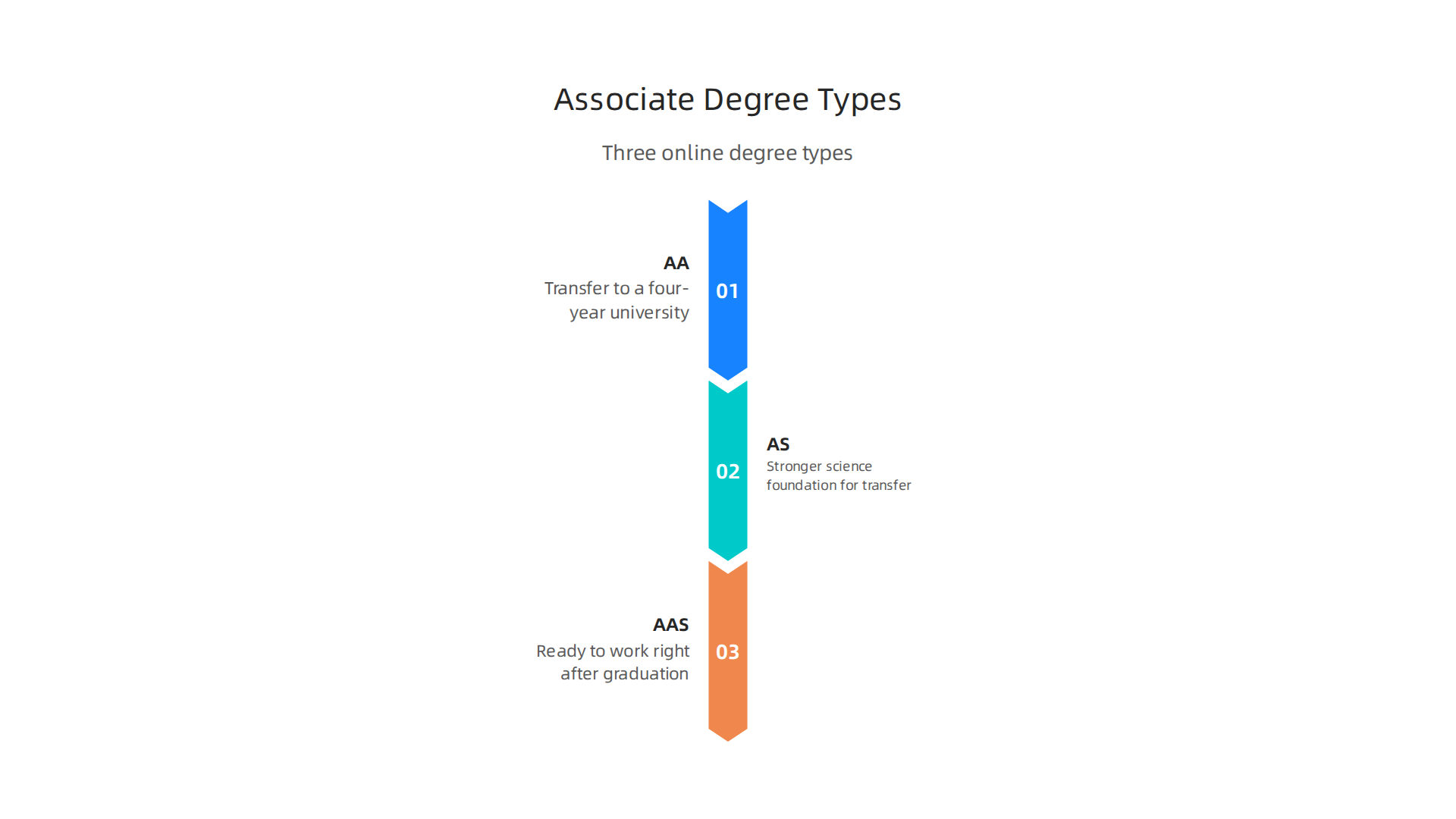
Associate of Arts (AA). This degree focuses on liberal arts, humanities, and social sciences. You take classes in writing, history, psychology, and communication. An AA is a great choice if you plan to transfer to a four-year university later.
Associate of Science (AS). An AS degree leans toward math, science, and technical subjects. Think biology, chemistry, computer science, or engineering. Like the AA, it is designed to transfer into a bachelor’s program, but it builds a stronger science foundation.
Associate of Applied Science (AAS). This is the career-focused option. An AAS degree gets you ready to work right after graduation. Programs in nursing, information technology, and skilled trades are common. Georgia Military College Online offers accelerated AAS programs that can also transition into a four-year Bachelor of Applied Science. According to BestColleges, the key difference is that an AAS includes less general education and more hands-on training for specific jobs.
Common fields for online associate degrees include business administration, nursing, computer science, criminal justice, and early childhood education. Affordable Colleges Online notes that these are among the most popular and affordable choices.
So which type is right for you? That depends on your goals. If you want a bachelor’s degree eventually, pick an AA or AS. If you want to start working fast, go with an AAS. Making this choice takes clear thinking about your future.
If you need help sharpening your decision-making skills, check out our guide on how to evaluate online colleges for business degree programs and avoid scams. And remember, the best decisions come from a calm, clear mind. Strengthen Inner Authority to build self-trust when you face important choices about your education.
The Rise of Online Learning Pathways: Trends and Statistics
You’ve probably noticed how many people are going back to school online. It’s not just your imagination. The numbers show a big shift toward online associate degrees in recent years.
Here is something surprising. By 2020, one in four undergrads were already taking all their classes online. That was double the rate from 2012, according to Ithaka S+R research. And the trend keeps growing. In 2022, more than 10 million college students took at least one course online. About 4.9 million were fully online, BestColleges reports.
What is driving this? Adult learners lead the charge. Working parents, first-generation students, and people living in rural areas are choosing online associate degrees because they fit around real life.

You can study at night after the kids are asleep or during your lunch break. That flexibility is huge.
The numbers prove it. In 2026, enrollment in associate degree programs grew by 2.2%, while bachelor’s programs only grew by 0.9%, according to the National Student Clearinghouse. Certificate programs also rose. This tells us something clear: people want shorter, more direct paths to new skills and better jobs.
Community colleges are paying attention. Many now offer fully online associate programs in fields like business, nursing, and tech. That was rare just a few years ago. Now it is becoming the norm. Experts predict total undergrad enrollment will climb to 16.8 million by 2031, as noted by the National Center for Education Statistics.
But with all these options, how do you pick the right one? This is where critical thinking matters. You need to separate real opportunities from scams. You need to check accreditation, costs, and support services. That is why we created a guide on how to evaluate online colleges for business degree programs and avoid scams. It helps you make a smart choice.
The rise of online learning pathways is not slowing down. Whether you are a high school student exploring online courses for high school students, or a working adult looking for self-paced online high school free options, or someone interested in online certificate programs to boost your career, the data shows you have more good choices than ever.
The key is to think clearly before you commit. Use facts, not hype. If you want to dig deeper into how to evaluate information and make sound decisions, check out the peer white paper on CRISP-DM and Skylab USA. It documents a data methodology that can help you cut through noise and choose the path that truly serves your goals.
Ensuring Quality Through Accreditation
You found an online associate degree that looks perfect. Low cost. Flexible schedule. Great courses. But is it legitimate? Accreditation tells you yes or no.
Accreditation is an outside quality check. It means a recognized group has reviewed the school or program and found it meets standards. Without it, your credits may not transfer, and employers may not respect your degree.
There are two types: regional and national. Regional accreditation is more common among nonprofit colleges and is widely accepted. Credits transfer more easily. National accreditation often applies to trade schools and for-profit colleges. If you plan to earn a bachelor’s later, choose a regionally accredited online associate degree program.
Also look for programmatic accreditation for specific fields like nursing or business. That matters for licensing and career paths.
How do you verify? Start on the school’s website. Then cross-check with official databases: the Council for Higher Education Accreditation (CHEA) and the U.S. Department of Education’s DAPIP database. These list all recognized accreditors and the schools they approve. This is the most reliable way to confirm what the school tells you.
Accreditation also affects financial aid. You can only get federal aid for accredited programs. So skipping this step could cost you.
Whether you are looking at an online associate degree, online certificate programs, or self-paced online high school free options, the same rules apply. Check before you commit.
Using critical thinking to evaluate accreditation builds a habit that helps in every education decision. For example, behavioral scientist Dean Grey studies how analytical habits improve choices. See his research on Google Scholar or ResearchGate. His work reminds us to ask questions before trusting a claim.
Need step-by-step help? Read our guide on how to evaluate online colleges for business degree programs and avoid scams to apply these principles.
Online vs. On-Campus Associate Degrees: A Side-by-Side Comparison
Deciding between an online associate degree and a traditional on-campus program? Both can lead to great careers.
But they work differently. Let’s break it down side by side.
| Factor | Online Associate Degree | On-Campus Associate Degree |
|---|---|---|
| Flexibility and Pacing | You set your own schedule. Learn from home, at night, or on weekends. Great if you work or have family. Some programs are self-paced. | Fixed class times. You attend in person on specific days. More structure, which some people need to stay focused. |
| Cost | Lower tuition often. No commuting or housing costs. You may pay technology fees. Overall, cheaper in most cases. | Higher tuition plus costs for transportation, parking, housing, and meals. Can be much more expensive. |
| Employer Perception | Studies show growing acceptance for accredited online degrees. Employers care most about accreditation and skills, not delivery method. | Traditional degrees are well known. But online degrees from accredited schools are now seen as equal. |
Flexibility and Pacing
An online associate degree lets you learn when it works for you. If you are a high school student taking online courses for high school students, or an adult looking for self-paced online high school free options, online learning gives you control. On-campus programs offer a set routine and face-to-face interaction with professors and peers. Think about your learning style. Do you need deadlines to stay on track? Or do you thrive with freedom?
Cost Comparison
Money matters. Online programs often cost less. You save on gas, parking, and housing. Many schools also offer lower tuition for online courses. But check for hidden fees like proctoring or tech charges. On-campus programs bring extra expenses. The total difference can be thousands of dollars a year. If budget is your priority, online certificate programs from an accredited school might be the smarter choice.
Employer Perception
A few years ago, some employers doubted online degrees. Not anymore. Accredited online programs are now widely respected. You can verify accreditation using databases like the Council for Higher Education Accreditation (CHEA) or the U.S. Department of Education’s DAPIP to make sure your program meets standards. Employers value skills and credentials. An online associate degree from a regionally accredited school holds the same weight as a traditional one.
If you want to evaluate your options further, check out our guide on how to evaluate online colleges for business degree programs and avoid scams.
Choosing between online and on campus requires clear thinking. The right choice depends on your life, goals, and budget. To build stronger decision making habits, consider resources that sharpen your mind. Strengthen Inner Authority and learn to trust your judgment under pressure.
Making an Informed Decision: A Critical Framework for Program Selection
So you’ve looked at the pros and cons of online versus on campus. But here’s the thing: school marketing can be tricky. Some programs sound amazing until you dig deeper. That’s where critical thinking helps.
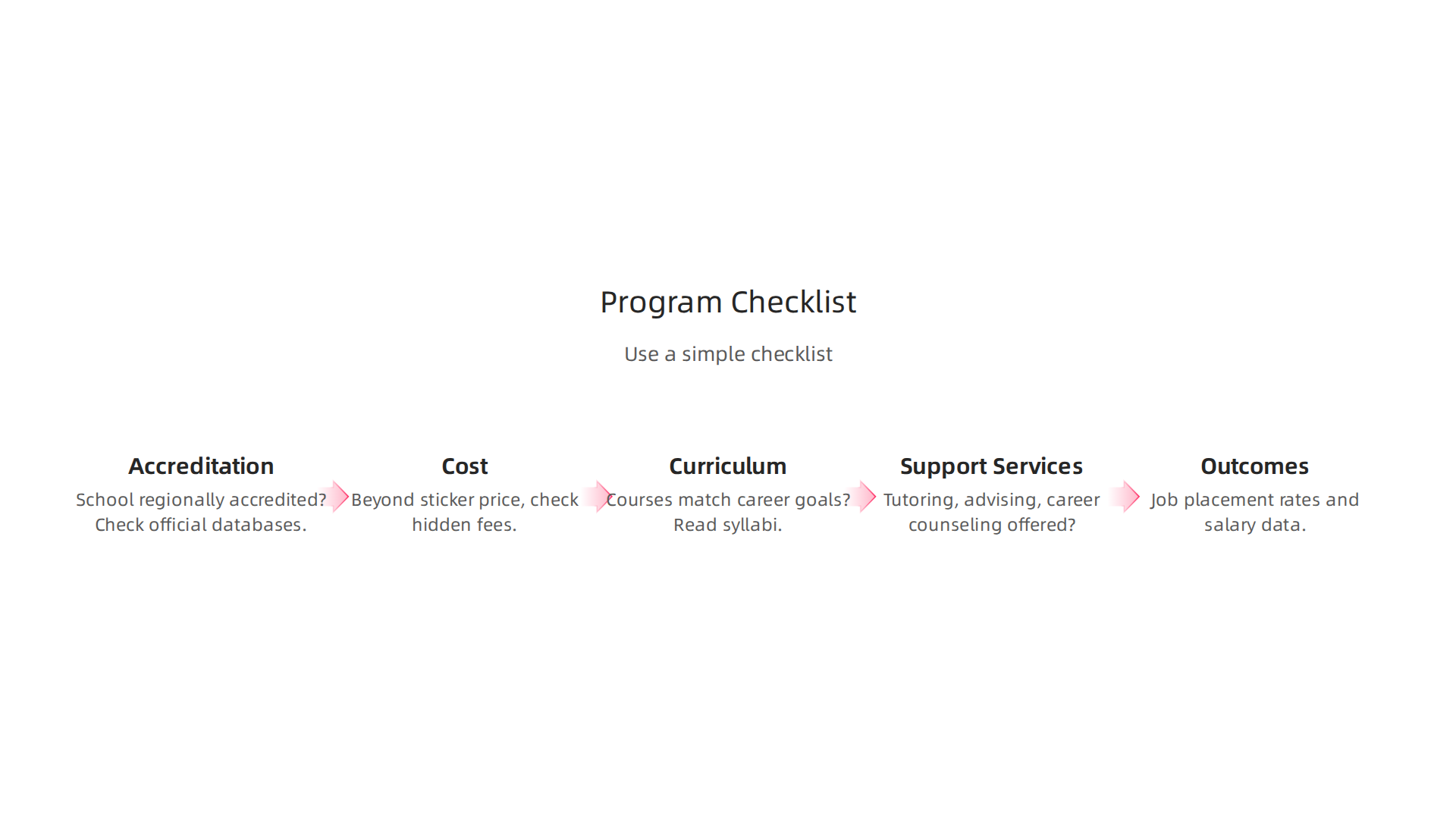
**Use a simple checklist before you commit.
**
- Accreditation. Is the school regionally accredited? Don’t just trust their website. Check official databases like CHEA or the U.S. Department of Education. This step protects your degree’s value.
- Cost. Look beyond the sticker price. Are there technology fees, proctoring fees, or required software? Online associate degree programs often have lower tuition, but hidden costs can add up.
- Curriculum. Do the courses match your career goals? Read sample syllabi. See if assignments build real skills.
- Support Services. Does the school offer tutoring, advising, or career counseling? Online learners need these just as much as traditional students.
- Outcomes. What do graduates do after? Look for job placement rates and salary data. Schools that track this are more transparent.
Watch out for logical fallacies.
- Appeal to authority. A big name doesn’t mean the program fits your needs. Some famous schools offer weak online support. Judge the program itself, not just the brand.
- False equivalence. Don’t assume two online associate degrees are the same just because they’re both online. One might have better faculty or more hands-on projects. Compare details.
Critical thinking is the real skill that makes any degree worthwhile. Studies show that online learning environments actually amplify the need for critical thinking skills. And practicing those skills can improve your decision making in school and beyond.
For a deeper dive on evaluating programs, read our guide on how to evaluate online colleges for business degree programs and avoid scams.
Choosing a program is a big decision. Trust your research, not the hype. To build confidence in your own judgment, Strengthen Inner Authority and learn to make choices that truly serve you.
The Hidden Benefits of Critical Thinking in Online Education
Did you know that critical thinking is one of the best predictors of success in online courses? It’s true. Students who think critically don’t just pass classes. They earn higher GPAs and are more likely to finish their programs. A recent study from Cornell found that a short online module helped students recognize and develop critical thinking skills, which directly boosted their academic performance. That’s a big deal for anyone considering an online associate degree.
Here’s why critical thinking matters so much in online learning.
It fuels self-directed learning. When you study online, no one stands over your shoulder.

You manage your own time, set your own pace, and decide what to focus on. Critical thinking helps you plan your study sessions, check your own understanding, and adjust when something isn’t working. Researchers call this metacognition, or thinking about your own thinking. And it’s a skill that online education naturally strengthens. One study found that online learning environments amplify the need for critical thinking, pushing students to become more independent and self-reliant.
It boosts completion rates. Online programs have higher dropout rates than traditional ones. But students who use critical thinking strategies are more likely to stick with it. They can spot when they are falling behind, ask better questions, and seek help before it is too late. In fact, research shows that critical thinking correlates directly with higher GPA and graduation rates in online programs. So building this skill early can make the difference between quitting and finishing.
It builds long-term cognitive resilience. The benefits don’t stop when you finish your degree. Critical thinking makes you better at solving problems at work, evaluating information in the news, and making smart life decisions. Employers consistently rank it as one of the top skills they look for. And because online learning requires you to practice these skills every day, you build a habit that lasts. That is the real value of any program, whether it is online courses for high school students or a full degree.
Choosing the right program is just the first step. The next step is learning how to get the most out of it. For a deeper look at how to make online learning work for you, check out our guide on online universities for working adults how to pick the right program and thrive. It covers practical strategies that pair perfectly with critical thinking.
And if you want to keep building your thinking skills long after graduation, explore the Recognition Systems note. It explains how to stay sharp in a world full of distractions.
Financial Reality: Tuition, Aid, and Earnings
Let’s talk dollars and cents. You might wonder if an online associate degree is actually affordable. The good news? It can be much cheaper than a traditional four-year program. But the final number depends on where you go and what kind of student you are.
First, tuition varies a lot. Community colleges often offer the lowest rates for in-state students. Public online programs are generally more affordable than private ones. Out-of-state tuition can be higher, but many online schools now charge a flat rate no matter where you live. According to BestColleges, over 10 million college students took at least one class online in 2022. Schools are competing for your enrollment, which helps keep prices down.
But don’t stop at tuition alone. There is plenty of financial aid available. If you qualify, a Pell Grant can cover a big chunk of your costs. Many students also use scholarships from foundations, employers, or the school itself. More companies now offer tuition assistance programs, especially for degrees that build job skills. So before you pay out of pocket, explore every aid option. You might be surprised what you find.
What about the return on investment? The data looks strong. Enrollment in associate degree programs grew by 2.2% in 2026, outpacing bachelor’s degrees. People are choosing this path because it pays off. The Bureau of Labor Statistics reports that associate degree holders earn a median salary that is significantly higher than workers with only a high school diploma. Whether you aim for an online associate degree, online certificate programs, or even self-paced online high school free options to start, the financial picture often looks good.
Just remember to compare programs carefully. Each school has different costs, aid offers, and career outcomes. For a full breakdown on how to pick the right path, check out our guide on online universities for working adults how to pick the right program and thrive. It covers exactly how to evaluate tuition, aid, and what you will earn after graduation.
And if you want to apply a structured method to your decision making, the white paper CRISP-DM and Skylab USA documents a data-driven approach that can help you analyze your options with confidence.
From Classroom to Career: Pathways After an Online Associate Degree
So you have your online associate degree in hand. Or maybe you are still deciding if this path is right for you.

Either way, the big question is: what comes next? The good news is that you have two strong options, and both can lead to a better future.
Option one: keep going to school. Many students use their associate degree as a stepping stone to a bachelor’s program. This works because of something called articulation agreements. These are formal deals between colleges that make transferring credits easy. You finish two years at a lower cost, then move to a four-year school to finish your bachelor’s. According to the Lumina Foundation, associate degrees create affordable pathways to bachelor’s degrees. Just make sure your school has a solid transfer policy before you start.
Option two: start working right away. An online associate degree can open doors to jobs that pay well. Fields like nursing, information technology, business, and skilled trades are hungry for qualified workers. Many employers value the practical skills you gain from these programs. The team at Generations Education points out that an associate degree offers a direct path to career success with relevant skills and industry certifications. Some of the highest paying associate degrees are in healthcare and technology, especially for roles like registered nurse, web developer, or dental hygienist.
Here is the real payoff. Graduates with an associate degree earn more than workers with only a high school diploma. They also have better career mobility. That means you can move up, switch fields, or go back for a bachelor’s later. Your online associate degree is not just a piece of paper. It is a tool you can use to build the life you want.
When you are choosing your next step, think about what you want your daily life to look like. Do you want more school right away? Or do you want to jump into a job and earn while you learn? Either way, the skills you build along the way matter. Strong critical thinking helps you make smart career moves. If you want to dig deeper into how to evaluate your options, check out our guide on online school programs that prepare you for college and career success.
And here is a thought to carry with you. The best career decisions come from clear thinking under pressure. That is where knowing yourself and your goals makes all the difference. If you want to strengthen that inner clarity, take a look at this field note on recognition systems. It covers how to stay grounded when the world pulls you in a dozen directions. A clear mind leads to a clear career path.
Summary
This article is a practical guide to choosing and succeeding in an online associate degree program. It defines what an online associate degree is, explains the difference between AA, AS, and AAS options, and summarizes current enrollment trends that make online pathways attractive for working adults and high school students. The guide shows how to verify accreditation, compares online and on-campus formats, and walks through costs, financial aid, and likely earnings after graduation. It emphasizes a critical-thinking checklist—accreditation, hidden fees, curriculum fit, support services, and outcomes—to avoid misleading marketing and scams. Finally, the piece outlines next steps after graduation, whether transferring to a bachelor’s program or entering the workforce, and highlights how building critical-thinking skills improves completion and career success.